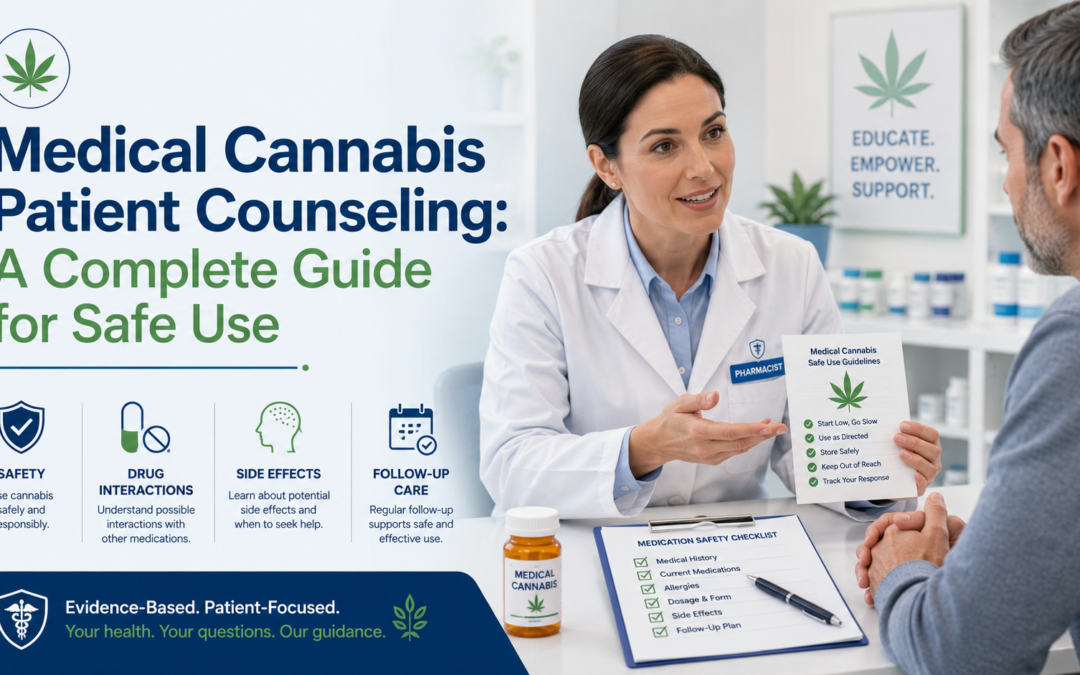
Medical cannabis patient counseling is a structured, safety-focused process that helps patients understand possible benefits, limitations, side effects, medication interactions, product differences, and follow-up needs before using cannabis-based products.
Pharmacists and other qualified healthcare professionals play an important role by helping patients make informed decisions while reducing avoidable medication and safety risks.
Medical cannabis is not risk-free, and it is not appropriate for every person or every health situation. Product quality, THC and CBD content, labeling standards, legal requirements, and access rules can vary widely across the United States and worldwide.
Patients should speak with a pharmacist, physician, or qualified healthcare professional before starting, stopping, or changing any cannabis-related product.
Key Takeaways
- Medical cannabis patient counseling should include medication review, safety education, product understanding, and follow-up planning.
- THC and CBD may cause side effects and may interact with prescription medicines, over-the-counter products, supplements, alcohol, and other substances.
- There is no one-size-fits-all cannabis dose, product, or route of use.
- Patients should avoid driving, operating machinery, or performing safety-sensitive tasks while impaired.
- Medical cannabis laws vary by U.S. state and by country.
- Pharmacist-led guidance can help patients ask better questions, understand risks, and communicate clearly with their healthcare team.
- Patients should seek professional advice before making treatment or medication decisions.
What Is Medical Cannabis Patient Counseling?
Medical cannabis patient counseling is the process of providing clear, evidence-informed guidance about the safe and responsible use of cannabis-based medicines or cannabis products. It is not simply a discussion about a product.
It is a broader conversation about the patient’s health goals, medication list, possible risks, local legal requirements, and need for monitoring.
For patients, counseling can make a confusing topic easier to understand. For pharmacists and healthcare professionals, it creates an opportunity to identify medication concerns, correct misinformation, and support safer care.
A complete counseling discussion may include:
- Why the patient is considering medical cannabis
- Current symptoms and treatment goals
- Prescription medicines, supplements, and other substances used
- Previous cannabis or CBD experience
- Product type, cannabinoid content, and route of use
- Possible side effects and impairment risks
- Drug interaction concerns
- Safe storage and responsible use
- Follow-up questions and referral needs
Medical cannabis counselling should be individualized. A patient using multiple medications, an older adult, a new cannabis user, and a person with complex health needs may each require different levels of support and monitoring.
Why Medical Cannabis Patient Counseling Matters
Patients may receive cannabis-related information from friends, social media, advertisements, dispensaries, or online forums. Some information may be useful, but some may be incomplete, overly promotional, or not relevant to the patient’s medical history.
Pharmacist-led cannabis patient counseling helps introduce a medication-safety perspective. Pharmacists are trained to review medication lists, identify potential interaction concerns, explain product differences, and encourage communication among members of the healthcare team.
Key goals of cannabis patient counseling
A strong counseling process can help patients:
- Understand that cannabis is not risk-free.
- Recognize that THC and CBD can affect people differently.
- Identify possible side effects and impairment concerns.
- Review prescription medicines and supplements for potential interactions.
- Avoid self-adjusting medicines without professional guidance.
- Use products responsibly and store them safely.
- Know when to seek medical or pharmacy advice.
- Understand that legal access does not always mean a product is clinically appropriate.
For healthcare professionals, medical cannabis patient education can support more respectful, non-judgmental conversations.
Patients may be more likely to disclose cannabis use when they feel heard and supported rather than criticized.
How Do Pharmacists Counsel Medical Cannabis Patients?
Pharmacists counsel medical cannabis patients by reviewing health goals, medication use, safety risks, cannabis experience, possible interactions, and follow-up needs. The goal is not to give every patient the same recommendation.
The goal is to help each patient make safer and better-informed decisions with their healthcare team.
1. Understand the patient’s reason for asking
A pharmacist may begin with simple, open-ended questions:
- What are you hoping to understand or improve?
- Have you used cannabis or CBD products before?
- Are you using any prescription or non-prescription medicines?
- Have you experienced unwanted effects from cannabis products in the past?
- Are you considering a particular product or route of use?
- What concerns do you have about safety, side effects, or interactions?
These questions help avoid assumptions. They also create a clearer starting point for patient education.
2. Review the full medication list
Cannabis drug interactions counseling begins with a complete medication review. Patients should be encouraged to disclose all relevant products, including:
- Prescription medicines
- Over-the-counter medicines
- Vitamins and supplements
- Herbal products
- CBD products
- Alcohol use
- Nicotine or tobacco products
- Other recreational substances, when clinically relevant
This step matters because interaction risk may depend on the product, dose, route, frequency of use, patient health status, and other medicines being taken.
3. Explain product and route differences
Patients may not understand the difference between THC, CBD, combination products, or routes such as oral, inhaled, sublingual, and topical products.
Counseling should explain that product effects can vary based on:
- THC and CBD concentration
- Product formulation
- Route of administration
- Timing and duration of effects
- Individual sensitivity
- Previous exposure or tolerance
- Other medicines or substances used
A patient should not assume that a product is low-risk simply because it is labeled “natural,” “CBD,” “hemp,” or “medical.”
4. Discuss side effects and impairment
Cannabis side effects counseling should include realistic, balanced information. Depending on the product and individual, unwanted effects may include drowsiness, dizziness, changes in alertness, impaired coordination, changes in mood, gastrointestinal symptoms, or cognitive effects.
Patients should be reminded not to drive, operate machinery, or perform safety-sensitive tasks while impaired. Combining cannabis with alcohol or other impairing substances may increase risk.
5. Use teach-back to confirm understanding
Teach-back is a simple but valuable counseling method. Instead of asking, “Do you understand?” the pharmacist can ask:
- “Can you tell me what you would do if you feel unusually dizzy or sedated?”
- “What will you check before using this product with your other medicines?”
- “When should you avoid driving or operating machinery?”
- “Who will you contact if you have side effects or concerns?”
Teach-back helps identify misunderstandings before they lead to unsafe decisions.
Medical Cannabis Dosing for Patients: Why There Is No Universal Dose
One of the most important parts of cannabis dosing counseling is explaining that there is no universal dose, product, or schedule that is appropriate for everyone.
A person’s response may differ based on age, body factors, health status, cannabis experience, medication use, product formulation, route of use, and desired treatment goals.
A product that another person finds tolerable may not be appropriate or safe for someone else.
Patients should avoid copying another person’s routine, relying on online anecdotes, or rapidly changing their use without professional guidance.
Practical counseling principles
Healthcare professionals can encourage patients to:
- Follow an individualized plan developed with a qualified clinician or pharmacist.
- Avoid making rapid changes without discussing concerns first.
- Read product labels carefully.
- Keep a record of product name, cannabinoid content, route, timing, symptoms, and side effects.
- Bring that record to follow-up appointments.
- Report new or concerning symptoms promptly.
- Avoid changing prescribed medicines independently.
Simple patient tracking guide
|
What to Track |
Why It Helps |
|
Product name and label details |
Helps distinguish products and formulations |
|
THC/CBD information |
Supports clearer product discussions |
|
Route of use |
Different routes may have different effects |
|
Time used |
Helps identify patterns |
|
Symptoms before and after use |
Supports patient follow-up |
|
Side effects |
Helps identify tolerability concerns |
|
Other medicines taken |
Supports interaction review |
|
Questions for the pharmacist |
Encourages safer communication |
Cannabis Drug Interactions Counseling: What Patients Should Know
Cannabis and CBD products may interact with prescription medicines, over-the-counter products, supplements, alcohol, and other substances.
The level of risk depends on many factors, including the product used, cannabinoid content, route, dose, frequency, health conditions, and other medicines.
Patients should not assume that CBD is interaction-free. Similarly, they should not assume that a legal cannabis product is automatically safe to combine with their current medicines.
Medication categories that may require extra review
A pharmacist may look more closely at patients using:
- Medicines that cause sedation or impair alertness
- Anticoagulants or antiplatelet medicines
- Anti-seizure medicines
- Opioids or other central nervous system depressants
- Certain antidepressants or psychiatric medicines
- Medicines with narrow therapeutic ranges
- Multiple medicines for chronic conditions
This is not a complete list. It is a reminder that individualized review is important.
Questions patients should ask
Patients can ask a pharmacist:
- Could this cannabis or CBD product affect any of my medicines?
- Should I be concerned about drowsiness or impaired coordination?
- Are there warning signs I should monitor?
- Do I need to avoid alcohol or other substances?
- Should I discuss this with my prescribing physician?
- What information should I bring to a follow-up appointment?
A good medication review does not promise that every risk can be eliminated. Instead, it helps patients understand uncertainty, identify concerns early, and make informed decisions with appropriate professional support.
Cannabis Side Effects Counseling and Safety Warnings
Cannabis is not risk-free. THC, CBD, and combination products may cause unwanted effects, and the risk may increase when products are used without professional guidance, combined with other medicines, or used in situations requiring full alertness.
Possible side effects to discuss
Side effects vary by product and person. They may include:
- Drowsiness or sedation
- Dizziness
- Reduced alertness
- Changes in coordination or reaction time
- Changes in memory or concentration
- Anxiety or unwanted psychological effects in some people
- Appetite changes
- Gastrointestinal symptoms
- Product-specific or individual reactions
Important safety warnings
Patients should be advised to:
- Avoid driving while impaired.
- Avoid operating machinery while impaired.
- Avoid combining cannabis with alcohol or other substances that may increase impairment.
- Keep products secured and away from children and pets.
- Avoid assuming that edible, topical, CBD, or hemp products are automatically low-risk.
- Discuss pregnancy, breastfeeding, mental health history, cardiovascular concerns, or substance-use concerns with a qualified healthcare professional.
- Seek urgent medical care for severe, unexpected, or concerning symptoms.
This article does not diagnose symptoms or replace emergency medical care. Patients who feel unsafe, severely unwell, confused, faint, or experience concerning chest symptoms should seek prompt medical attention.
Safe Medical Cannabis Use: Patient Education Best Practices
Safe medical cannabis use depends on clear communication, realistic expectations, and ongoing monitoring. Patient education should not be limited to the first conversation.
Use clear and non-judgmental language
Patients may hesitate to discuss cannabis use because they fear stigma or judgment. Healthcare professionals can create better conversations by:
- Asking respectful, open-ended questions
- Listening without assumptions
- Explaining uncertainty honestly
- Correcting misinformation calmly
- Encouraging full disclosure of cannabis use
- Focusing on safety and patient goals
Encourage responsible product use
Patients should understand the importance of:
- Checking labels and product information
- Keeping products in original containers when possible
- Avoiding accidental sharing of products
- Storing products securely
- Avoiding use in unsafe environments
- Considering workplace and driving rules
- Checking local laws before travel or transport
Promote reliable information sources
Patients should be encouraged to seek evidence-based information from public health agencies, qualified healthcare professionals, peer-reviewed research, state regulatory boards, and professional pharmacy organizations.
Social media stories and product marketing may not provide complete information about quality, interactions, or patient-specific safety.
Medical Cannabis Patient Follow-Up: Why It Is Essential
Medical cannabis patient follow up helps patients and healthcare professionals review changes over time.
It is particularly important for new users, patients taking multiple medicines, people who experience side effects, and patients whose health status or medication list has changed.
Topics to review during follow-up
A pharmacist or healthcare professional may ask:
- What product is the patient using?
- How is the product being used?
- Has the patient experienced side effects?
- Has the patient started or stopped any other medicines?
- Has the patient experienced changes in alertness, coordination, sleep, or mood?
- Does the patient have questions about driving, work, or storage?
- Does the patient need referral to a physician or another healthcare professional?
Follow-up does not mean that every patient needs the same schedule. It means that counseling should remain responsive to the patient’s situation and evolving needs.
Common Myths and Mistakes About Medical Cannabis
Myth: Natural means risk-free
Natural origin does not automatically make a product safe, effective, interaction-free, or appropriate for every patient.
Myth: CBD cannot interact with medicines
CBD-containing products may require medication review. Patients should not assume CBD is harmless simply because it is non-intoxicating or widely available.
Myth: Higher doses always work better
More is not always better. Increasing use may also increase side effects, impairment, cost, and medication-safety concerns.
Myth: Legal means medically appropriate
Legality and clinical suitability are different issues. A product may be legally available in a location but still require thoughtful medication review and professional guidance.
Mistake: Not telling the healthcare team
Not disclosing cannabis use can make it harder for pharmacists and prescribers to assess interactions, side effects, and safety concerns.
Mistake: Following another person’s routine
A friend’s product, experience, or dose may not be safe or relevant for another person. Individual health history and medication use matter.
Why Medical Cannabis Patient Counseling Matters in the United States
The United States has a complex cannabis environment. Medical cannabis laws, qualifying conditions, patient registration systems, product regulations, pharmacist roles, and workplace protections can differ from one state to another.
For patients, this can be confusing. A product may be available in one location but restricted in another. Labeling requirements and testing practices may also differ. Patients should avoid relying on information from a different state without confirming current local requirements.
For pharmacists and healthcare professionals, this environment creates a need for ongoing education in:
- Cannabis pharmacology
- Patient counseling
- Drug interaction awareness
- Product quality concerns
- Documentation practices
- State-specific legal and regulatory context
- Communication with patients and other clinicians
The need for responsible, evidence-based education is especially important because cannabis-related questions may arise in community pharmacy, hospital practice, ambulatory care, academia, public health, and patient education settings.
Why Cannabis Counseling Matters Globally
Medical cannabis counseling is not only relevant in the United States. Pharmacists, healthcare professionals, students, and patients around the world may encounter cannabis-based medicines, CBD products, self-directed cannabis use, or imported products.
However, laws and healthcare practices vary widely between countries. Some jurisdictions allow specific cannabis-based medicines under strict rules, while others limit or prohibit access. Product standards, prescribing authority, pharmacy roles, and patient protections may also differ.
The shared global need is not a single universal cannabis rule. It is better education about:
- Medication safety
- Drug interaction awareness
- Product quality and labeling
- Patient-centered communication
- Professional boundaries
- Evidence appraisal
- Local legal and regulatory requirements
Healthcare professionals should always consider their country’s laws, scope-of-practice rules, and clinical guidance before providing cannabis-related advice.
The Role of Cannabis Pharmacists and Pharmacy Education
A cannabis pharmacist is a pharmacy professional who applies medication expertise to cannabis-based medicines, patient education, product questions, drug interaction awareness, and clinical communication.
Pharmacists can help bridge the gap between patient interest and medication safety. They may not replace the role of the physician or prescribing clinician, but they can provide valuable support through medication review, education, monitoring, and referral.
Areas where cannabis pharmacy education can help
Professional cannabis education may strengthen understanding of:
- Cannabinoid science
- THC versus CBD
- The endocannabinoid system
- Product formats and labeling
- Cannabis drug interactions
- Adverse effect recognition
- Patient counseling techniques
- Evidence evaluation
- Legal and regulatory awareness
- Documentation and inter professional communication
Pharmacy students and healthcare professionals benefit when cannabis education is grounded in current evidence, ethical practice, and patient safety rather than promotional claims or anecdotal information alone.
Why Choose cannabis pharmacist for Evidence-Based Cannabis Education
Cannabis pharmacists and the International Society of Cannabis Pharmacists support pharmacists, pharmacy students, healthcare professionals, and informed patients who want a more responsible approach to cannabis education.
The focus should remain on evidence-based learning, medication safety, patient counseling, professional development, drug interaction awareness, and legal context.
Relevant resources may include:
- Cannabis pharmacy education
- Continuing education opportunities
- Clinical cannabinoid pharmacy certificate programs
- Professional membership resources
- Webinars and learning materials
- Cannabis education for pharmacy students
- Networking and professional development opportunities
- Evidence-based patient safety guidance
Rather than offering one-size-fits-all cannabis recommendations, cannabis pharmacists can help learners develop the knowledge and confidence to ask better questions, assess evidence carefully, and communicate responsibly.
When to Speak With a Cannabis Pharmacist or Healthcare Professional
Patients should speak with a cannabis pharmacist, physician, or qualified healthcare professional before making medical decisions if they:
- Take prescription medicines or multiple medicines
- Have experienced cannabis-related side effects
- Are considering THC- or CBD-containing products
- Have questions about possible medication interactions
- Are pregnant, breastfeeding, or planning pregnancy
- Have mental health, cardiovascular, or substance-use concerns
- Are older adults or managing complex health conditions
- Need help understanding product labels
- Are unsure about driving, work, travel, or local laws
- Want to change prescribed medicines because of cannabis use
Professional guidance is especially important when cannabis is being considered alongside ongoing medical treatment.
Build Your Cannabis Pharmacy Knowledge With cannabispharmacist
Looking for evidence-based cannabis education that puts patient safety first?
Explore cannabis pharmacist and ISCPh resources to:
- Learn from cannabis pharmacists
- Strengthen cannabis patient counseling skills
- Understand cannabis drug interaction considerations
- Access continuing education opportunities
- Explore the Clinical Cannabinoid Pharmacy Certificate
- Connect through professional membership
- Build confidence in responsible cannabis pharmacy practice
FAQs
How do pharmacists counsel medical cannabis patients?
Pharmacists review the patient’s health goals, medication list, cannabis experience, side-effect concerns, possible interactions, product questions, and need for follow-up.
What medications interact with medical cannabis?
Potential interactions depend on the cannabis product, route, dose, health conditions, and other medicines used. Patients taking prescription medicines should ask a pharmacist for an individualized medication review.
How should patients start medical cannabis safely?
Patients should not self-direct treatment changes. They should discuss product considerations, health risks, medication interactions, and follow-up needs with a qualified healthcare professional.
Can CBD interact with prescription medicines?
Yes. CBD products may interact with some medicines. Patients should not assume CBD is interaction-free and should review all products with a pharmacist or healthcare professional.
Is medical cannabis safe for everyone?
No. Cannabis is not appropriate for every person or situation. Safety depends on health history, medicines, product type, dose, route, impairment risk, and local regulations.
Should patients drive after using medical cannabis?
Patients should not drive, operate machinery, or perform safety-sensitive tasks while impaired.
Why is medical cannabis patient follow-up important?
Follow-up helps identify side effects, medication changes, interaction concerns, product questions, and whether the patient needs additional clinical support.
Do cannabis laws vary by state and country?
Yes. Cannabis laws, patient access rules, product regulations, workplace restrictions, and transport rules can vary by U.S. state and by country.