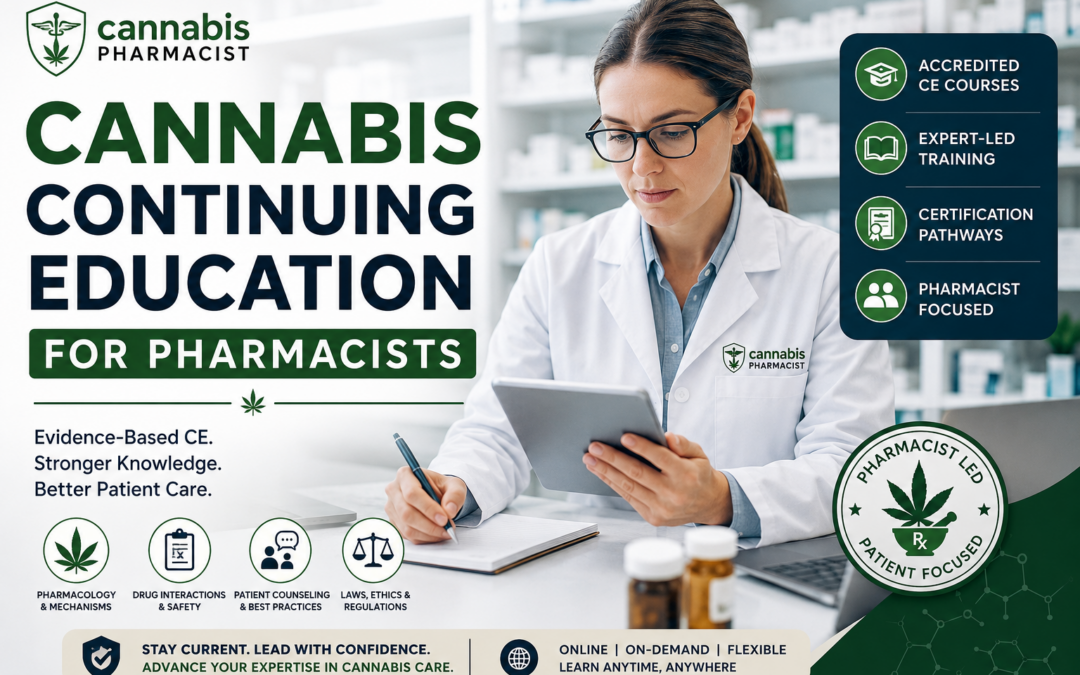
Cannabis Continuing Education for Pharmacists helps pharmacy professionals understand THC, CBD, cannabis pharmacology, drug interactions, patient counseling, product variability, and legal awareness.
A high-quality program should be evidence-based, clinically useful, transparent about its accreditation status, and designed to support safer conversations with patients and healthcare teams.
Cannabis education is no longer only about knowing product names or following state trends. Pharmacists may be asked whether CBD can interact with prescription medicines, whether a patient can drive after using THC.
Whether a cannabis edible has delayed effects, or how to document cannabis use during medication reconciliation. These questions require professional judgment, current evidence, and a safety-focused approach.
This guide explains how to evaluate cannabis CE for pharmacists, compare continuing education with certificate programs, identify meaningful course content, and build a long-term learning pathway.
It is intended for education only and does not provide personalized medical, legal, or treatment advice.
Key Takeaways
- Cannabis CE for pharmacists should cover pharmacology, THC, CBD, drug interactions, patient counseling, product quality, and legal awareness.
- Not every cannabis course automatically provides accredited continuing education credit.
- Pharmacists should verify the provider, activity details, credit amount, completion requirements, and expiration date before enrolling.
- Cannabis is not risk-free. THC and CBD may cause side effects and may interact with prescription medicines, over-the-counter products, supplements, alcohol, and other substances.
- Certificate programs and single CE courses serve different professional-development goals.
- Online cannabis CE can be valuable when it is evidence-based, current, pharmacist-led, and transparent about accreditation.
- Cannabis laws, pharmacy practice rules, and product regulations vary by U.S. state and by country.
- Patients should speak with a pharmacist, physician, or qualified healthcare professional before making cannabis-related medical decisions.
What Is Cannabis Continuing Education for Pharmacists?
Cannabis continuing education for pharmacists is structured professional learning focused on cannabis-related clinical knowledge and patient safety.
Depending on the course, it may cover cannabinoid pharmacology, THC and CBD, cannabis pharmacokinetics, drug interactions, patient couhttps://cannabispharmacist.org/ce-arcp-2021/nseling, product quality, evidence appraisal, legal issues, and clinical documentation.
The goal is not to encourage cannabis use or to suggest that cannabis is appropriate for every person. The goal is to help pharmacy professionals evaluate questions responsibly, recognize safety concerns, understand uncertainty, and communicate with patients in a clinically appropriate way.
A well-designed medical cannabis continuing education program should help pharmacists answer practical questions such as:
- What is the difference between THC and CBD?
- What products should be included in a medication history?
- How can cannabis affect prescription medicines?
- What should a pharmacist ask before discussing a cannabis product?
- How should a patient be counseled about impairment and delayed effects?
- What are the limits of available evidence?
- When should a pharmacist recommend referral to another healthcare professional?
Why Cannabis Continuing Education for Pharmacists Matters
Pharmacists are medication experts and patient advocates. They are often among the most accessible healthcare professionals, which means patients may ask them questions about cannabis products before discussing those products with a prescriber.
A patient may not describe cannabis as a medication. They may say they are using:
- A CBD gummy
- A hemp oil
- A THC sleep product
- A cannabis vape
- A dispensary tincture
- A topical cream
- A wellness supplement
- An edible for stress, discomfort, or sleep
These descriptions matter because product ingredients, THC-to-CBD ratios, routes of administration, labeling standards, and potential interaction risks can differ widely.
Cannabis training for pharmacists supports better medication reconciliation. It also helps pharmacists ask respectful, nonjudgmental questions. For example:
“Many patients use CBD, hemp, cannabis, or dispensary products. Are you using any of these so I can check for possible medication or safety concerns?”
This approach can improve disclosure, reduce stigma, and support safer patient communication.
What Pharmacists Should Be Able to Do After Cannabis Training
After completing high-quality cannabis pharmacist CE, a learner should be better prepared to:
- Explain basic THC and CBD pharmacology.
- Understand the endocannabinoid system at an appropriate clinical level.
- Recognize common routes of cannabis administration.
- Identify delayed-onset concerns with oral cannabis products.
- Ask about cannabis use during medication reviews.
- Recognize potential pharmacokinetic and pharmacodynamic interactions.
- Explain why product quality and labeling matter.
- Provide general impairment and storage counseling.
- Identify when referral or prescriber collaboration is appropriate.
- Follow current local legal, regulatory, and practice requirements.
What Should Medical Cannabis Continuing Education for Pharmacists Cover?
A strong medical cannabis CE for pharmacists should cover more than broad claims about cannabis. It should focus on practical clinical knowledge, patient safety, evidence limitations, and responsible decision-making.
Cannabis Pharmacology and the Endocannabinoid System
A course should explain the endocannabinoid system in clear language. This includes endogenous cannabinoids, cannabinoid receptors, enzymes, and the general role of these pathways in human physiology.
Pharmacists do not need to promise that cannabis will solve every problem connected to the endocannabinoid system.
Instead, they should understand that cannabinoids can affect multiple body systems, which is one reason clinical responses and side effects may vary from person to person.
Relevant learning topics include:
- CB1 and CB2 receptor concepts
- THC pharmacology
- CBD pharmacology
- Minor cannabinoids and evidence limitations
- Cannabinoid signaling pathways
- Pharmacodynamics
- Cannabis pharmacokinetics
- Product ratios and formulations
THC and CBD: Key Differences for Pharmacy Practice
THC and CBD should not be treated as interchangeable.
THC is the primary intoxicating cannabinoid commonly associated with altered perception, impaired coordination, changes in attention, and slower reaction time. THC-related safety concerns may include sedation, dizziness, anxiety, impaired judgment, falls, and driving impairment.
CBD does not usually produce the same intoxicating effects associated with THC. However, CBD is not risk-free. It may affect drug metabolism, interact with other medicines, and present product-quality concerns depending on formulation, dose, labeling, and source.
A useful cannabis course for pharmacists should teach learners how to explain these differences without oversimplifying them.
| Topic | THC | CBD | Clinical Relevance |
| Intoxicating effect | Commonly associated with intoxication | Not typically intoxicating in the THC-like sense | Product counseling and impairment review |
| Common safety concern | Sedation, anxiety, impaired coordination | Drug metabolism, side effects, label accuracy | Medication review |
| Interaction consideration | Additive impairment or sedation | Possible metabolism-related interaction concerns | Patient-specific evaluation |
| Product variability | High | High | Label review and quality awareness |
Drug Interactions and Medication Safety
Cannabis drug interactions are one of the most important topics in cannabis CE for pharmacists. Education should explain both major interaction categories.
Pharmacokinetic interactions occur when cannabis compounds affect how another medication is absorbed, metabolized, distributed, or eliminated. CBD, THC, and cannabis-derived products may affect liver enzymes or other pathways involved in medication processing.
Pharmacodynamic interactions occur when cannabis and another substance have overlapping effects. For example, combining cannabis with alcohol, sedatives, opioids, or other central nervous system depressants may increase drowsiness, impaired coordination, or reduced alertness.
Cannabis training should encourage pharmacists to review:
- Prescription medications
- Over-the-counter products
- Vitamins and supplements
- Herbal products
- Alcohol use
- Other substance use
- Product ingredients
- Route of administration
- Frequency of use
- Age and fall risk
- Liver or kidney concerns
- Medicines requiring close monitoring
Medication categories that may require additional attention include anticoagulants, anti-seizure medicines, sedatives, opioids, antidepressants, anti-anxiety medicines, cardiovascular medicines, immunosuppressants, transplant medicines, and medicines with narrow therapeutic-index concerns.
This does not mean every patient must avoid cannabis. It means pharmacists should perform careful medication review and collaborate with the prescriber when necessary.
Patient Counseling and Communication
Medical cannabis training for pharmacists should include communication skills, not only pharmacology.
Patients may be reluctant to mention cannabis use because of stigma, uncertainty, legal concerns, or fear of judgment. A pharmacist should create a respectful environment while still addressing safety.
Core counseling topics should include:
- Cannabis is not risk-free.
- THC and CBD may affect people differently.
- Product quality and labeling may vary.
- Oral products may have delayed effects.
- Cannabis can impair driving and safety-sensitive activities.
- Alcohol and sedating substances may increase impairment.
- Cannabis products should be stored securely away from children and pets.
- Prescription medications should not be stopped or changed without professional guidance.
- Patients should report new symptoms or concerning side effects.
A pharmacist should also understand when to refer. Referral may be appropriate when a patient has complex polypharmacy, unusual symptoms, a significant interaction concern.
Pregnancy or breastfeeding considerations, mental-health concerns, substance-use concerns, or questions outside the pharmacist’s scope.
Are Cannabis CE Courses Accredited for Pharmacists?
Some cannabis CE courses may be accredited, but accreditation should never be assumed. A pharmacist should verify the status of each individual activity before enrolling or depending on it for license renewal.
Accreditation may depend on the provider, the specific activity, the activity date, the credit type, the completion deadline, and applicable state-board requirements.
What to Verify Before Enrolling
| What to Check | Why It Matters |
| Provider name | Identifies the organization responsible for the activity |
| Accreditation statement | Confirms whether CE is currently offered |
| Activity title | Ensures the course matches the desired topic |
| Learning objectives | Shows whether the activity is clinically relevant |
| Credit amount | Supports CE planning |
| Activity format | Clarifies whether it is live, online, on-demand, or hybrid |
| Completion deadline | Some CE activities have time limits |
| Assessment requirements | Identifies post-tests, evaluations, or participation rules |
| Faculty credentials | Supports educational credibility |
| Conflict-of-interest disclosure | Promotes transparency |
| Reference list and update date | Helps assess whether content is current |
| Reporting process | Explains how completed credit is documented |
Important Accreditation Reminder
An organization may offer excellent cannabis education without every educational offering being accredited. Likewise, an accredited provider may offer activities with different eligibility periods or requirements.
Before enrolling, pharmacists should confirm:
- The activity is currently active.
- The CE credit applies to their professional needs.
- The provider’s accreditation statement is visible.
- The activity has not expired.
- The course meets any state-specific renewal requirements.
- The reporting method is clear.
International learners should also verify whether U.S.-based CE credit is recognized by their own licensing body, employer, or professional regulator.
Cannabis CE Courses vs Cannabis Certificate Programs
Cannabis CE courses and certificate programs can both support professional development, but they usually serve different purposes.
Cannabis CE Courses
A cannabis CE course is usually focused on a defined topic. It may be useful for pharmacists who want targeted learning in areas such as:
- THC and CBD pharmacology
- Cannabis drug interactions
- Patient counseling
- Product quality and labeling
- Medical cannabis safety
- Legal and regulatory developments
- Cannabis in older adults
- Cannabis in patients using multiple medicines
- Documentation and communication
These courses may be especially useful for pharmacists who want to update knowledge in a specific area or complete continuing education requirements.
Cannabis Certificate Programs
A certificate program is often broader and more structured. It may include multiple modules, expert instruction, clinical cases, knowledge assessments, and competency-focused learning.
A structured clinical cannabinoid pharmacy certificate may cover:
- Endocannabinoid system fundamentals
- THC and CBD pharmacology
- Cannabis pharmacokinetics
- Drug-interaction awareness
- Patient counseling
- Product formulation and quality
- Legal and regulatory awareness
- Clinical documentation
- Evidence interpretation
- Case-based learning
| Feature | Cannabis CE Course | Cannabis Certificate Program |
| Main purpose | Focused education | Broader competency development |
| Time commitment | Often shorter | Often more extensive |
| Best for | Topic-specific learning | Comprehensive learning pathway |
| Assessment | May include a post-test | May include multiple assessments |
| Professional outcome | CE credit or knowledge update | Structured credential or certificate pathway |
| Accreditation | Verify each activity | Verify certificate and individual CE components |
Neither format is automatically better. The best choice depends on the learner’s role, experience, professional goals, and required depth of knowledge.
How to Choose an Online Cannabis CE Course for Pharmacists
Online cannabis CE for pharmacists can be a flexible option, but quality varies. Before enrolling, evaluate the course as carefully as you would evaluate a clinical resource.
Look for Evidence-Based Content
A strong course should:
- Use peer-reviewed research where appropriate.
- Cite FDA, NIH, NCCIH, CDC, PubMed, state regulatory boards, and professional pharmacy organizations.
- Discuss potential benefits and risks in a balanced language.
- Avoid unsupported cure claims.
- Explain evidence limitations.
- Address safety, drug interactions, and patient counseling.
- Include current legal and regulatory information.
Review Faculty and Reviewer Credentials
Look for programs developed, taught, or reviewed by qualified professionals, such as:
- Licensed pharmacists
- PharmD professionals
- Clinical pharmacists
- Pharmacologists
- Physicians with relevant clinical expertise
- Cannabis education professionals
- Researchers with cannabinoid-related expertise
Faculty credentials alone do not guarantee quality, but they help readers assess whether the education is professionally grounded.
Look for Practical Pharmacy Relevance
The course should answer practical questions.
For example:
- How should cannabis use be documented in medication histories?
- What questions should be asked before discussing THC or CBD?
- Which medications may require closer interaction review?
- How should oral cannabis products be discussed?
- What counseling is appropriate for driving, impairment, storage, and alcohol use?
- When should the pharmacist involve the prescriber?
Watch for Red Flags
Be cautious when a course:
- Claims cannabis is safe for everyone.
- Promises universal clinical outcomes.
- Focuses only on products and not patient safety.
- Does not disclose faculty credentials.
- Has no reference list.
- Makes unclear accreditation claims.
- Ignores THC and CBD interaction concerns.
- Does not discuss legal variability.
- Uses sales language instead of clinical education.
Cannabis Training for Pharmacists in the United States
Cannabis education is particularly relevant in the United States because cannabis laws, medical programs, product access, and pharmacy practice requirements differ across states.
A product that is legal in one state may be regulated differently in another. Product testing, labeling, purchase rules, possession limits, employer policies, and medical cannabis program requirements may also vary.
For pharmacists, this means education should include both clinical knowledge and legal awareness.
U.S. Learning Priorities
Cannabis CE for pharmacists in the United States should address:
- State cannabis program differences
- State board of pharmacy requirements
- Federal and state regulatory context
- Product-label and quality concerns
- FDA-approved cannabinoid medicines versus consumer cannabis products
- Medication-safety communication
- CPE reporting and activity verification
- Driving and workplace safety
- Patient referral pathways
A pharmacist should not assume that legal availability means a cannabis product is clinically appropriate for every patient. Legal access and patient safety are different questions.
Worldwide Relevance for Pharmacy Professionals
Cannabis education is relevant globally because pharmacists and healthcare professionals may encounter cannabis, CBD, hemp-derived products, prescription cannabinoid medicines, and patient questions in many practice settings.
However, laws and professional responsibilities vary widely by country. Some countries permit cannabis-based medicines under tightly regulated systems.
Others restrict access, limit prescribing, or treat cannabis products differently under national law.
International learners should focus on transferable clinical principles:
- Evidence-based pharmacology
- Medication-safety review
- Product-quality awareness
- Patient counseling
- Documentation
- Referral and collaboration
- Local regulatory compliance
A course designed for U.S. pharmacists may still offer useful scientific knowledge to worldwide learners. However, legal and licensing information should always be checked against the learner’s own country, region, workplace, and regulatory authority.
Common Myths and Mistakes About Cannabis CE
Myth: Every Cannabis Course Provides Accredited Credit
Not every cannabis course provides accredited CE credit. Always verify the current activity-level accreditation statement, provider, credit amount, completion requirements, and expiration date.
Myth: Cannabis Education Is Only About Product Knowledge
High-quality education should cover pharmacology, drug interactions, patient counseling, documentation, legal awareness, and safety. Product descriptions alone are not enough for clinical practice.
Myth: Cannabis Is Risk-Free Because It Is Legal
Legal status does not remove the possibility of side effects, impairment, drug interactions, product variability, or patient-specific risk.
Myth: CBD Does Not Need Medication Review
CBD may affect drug metabolism and should be included in a patient’s medication and supplement history.
Myth: A Certificate Eliminates the Need for Ongoing Learning
Cannabis evidence, regulation, products, and clinical practice considerations can change. Continuing education remains important even after a certificate program is completed.
When to Speak With a Cannabis Pharmacist or Healthcare Professional
Patients should speak with a cannabis pharmacist, physician, or qualified healthcare professional before making medical decisions if they:
- Take prescription medicines, especially multiple medicines.
- Use anticoagulants, anti-seizure medicines, opioids, sedatives, antidepressants, heart medicines, or transplant medicines.
- Are considering THC, CBD, hemp products, edibles, oils, vapes, capsules, or concentrates.
- Experience sedation, dizziness, anxiety, falls, palpitations, confusion, or unusual symptoms.
- Are pregnant, breastfeeding, older adults, or caring for children.
- Have complex medical conditions or medication-monitoring needs.
- Are unsure whether cannabis could affect their current treatment plan.
- Need help understanding product labels, THC-to-CBD ratios, interactions, or local restrictions.
Why Choose cannabispharmacist for Evidence-Based Cannabis Education
Cannabis pharmacists and the International Society of Cannabis Pharmacists support a pharmacist-centered approach to cannabis education. The focus is not simply on product awareness.
It is on building knowledge that supports medication safety, patient counseling, evidence interpretation, professional development, and responsible clinical communication.
A strong professional learning pathway may include:
- Cannabis pharmacology education
- THC and CBD training
- Cannabis drug-interaction awareness
- Patient counseling resources
- Continuing education
- Certificate pathways
- Professional networking
- Clinical learning opportunities
- Pharmacy student engagement
- Membership resources
For pharmacists, the goal is to become more prepared to ask the right questions, understand possible risks, identify evidence limitations, and collaborate with other healthcare professionals when needed.
Build Your Cannabis Pharmacy Knowledge With cannabispharmacist
Evidence-based cannabis continuing education can help pharmacists strengthen medication reviews, improve patient counseling, recognize drug-interaction concerns, and communicate more confidently about THC, CBD, and cannabis products.
Explore cannabis pharmacy education, continuing education opportunities, professional resources, membership, and the Clinical Cannabinoid Pharmacy Certificate through cannabispharmacist and ISCPh.
FAQs
Are cannabis CE courses accredited for pharmacists?
Some cannabis CE courses may provide accredited credit, but accreditation is activity-specific. Pharmacists should verify the provider, activity details, credit amount, and completion deadline before enrolling.
Do pharmacists need cannabis continuing education?
Cannabis continuing education can help pharmacists answer patient questions, recognize possible medication risks, provide safety counseling, and understand current evidence and regulations.
What should a cannabis CE course include?
A strong course should include cannabinoid pharmacology, THC and CBD, drug interactions, product quality, patient counseling, safety, evidence appraisal, and legal considerations.
Can pharmacists take online cannabis CE courses?
Yes. Online cannabis CE can be valuable when the course is evidence-based, clearly accredited where applicable, clinically relevant, and taught or reviewed by qualified professionals.
What is the difference between cannabis CE and a certificate program?
Cannabis CE courses usually focus on individual topics and continuing education credit. Certificate programs typically provide a broader, more structured learning pathway with multiple modules or assessments.
Can pharmacy students study cannabis education?
Yes. Pharmacy students can learn about cannabis pharmacology, patient safety, drug interactions, product quality, and legal awareness through structured educational resources and professional organizations.
Is cannabis education only useful in states with legal cannabis?
No. Pharmacists may encounter questions about CBD, hemp products, prescription cannabinoid medicines, cannabis exposure, and medication interactions regardless of state law.
Can THC and CBD interact with medicines?
THC and CBD may interact with some medicines through metabolism changes, sedation, impairment, or other overlapping effects. Patients should discuss cannabis use with a pharmacist or qualified healthcare professional.
[/et_pb_text][/et_pb_column][/et_pb_row][/et_pb_section]