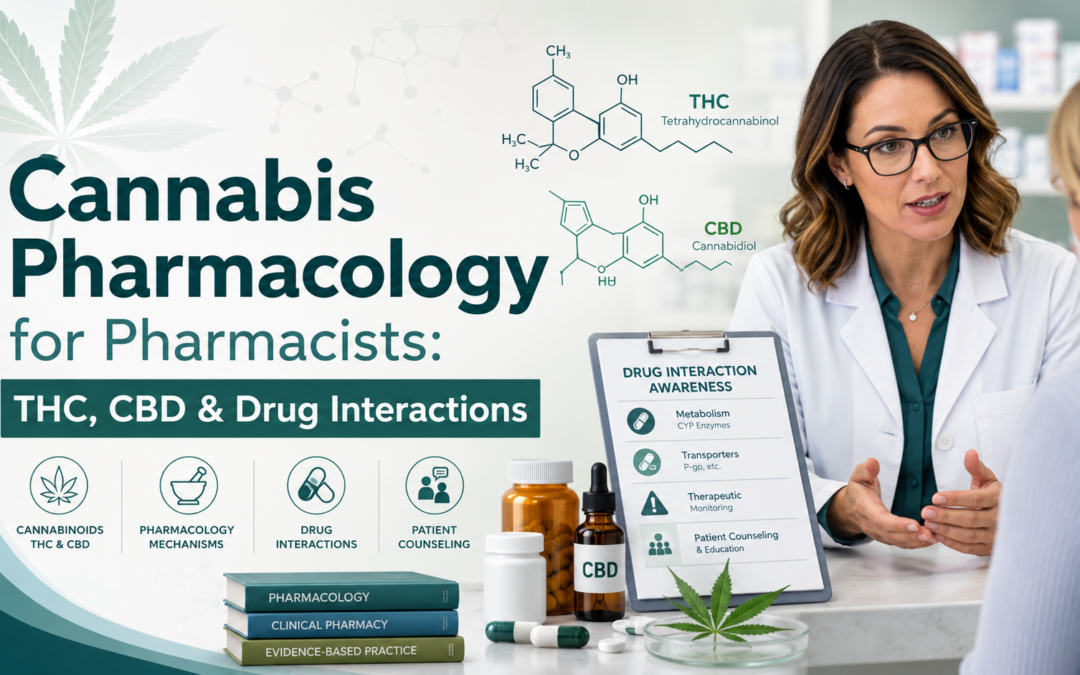
Cannabis pharmacology for pharmacists means understanding how THC, CBD, and other cannabinoids affect the body, how they may interact with medicines, and how pharmacists can help patients use cannabis products more safely.
It includes the endocannabinoid system, cannabis pharmacokinetics, product quality, drug metabolism, side effects, legal awareness, and patient counseling.
As cannabis use and medical cannabis programs expand, pharmacists are increasingly asked questions about THC, CBD, edibles, tinctures, vapes, hemp-derived products, sleep products, pain products, and possible drug interactions.
Clear, evidence-based guidance is essential because cannabis is not risk-free, products vary widely, and cannabis laws differ by U.S. state and country.
This guide is for education only. It does not provide personalized medical advice, recommend a specific cannabis product, or replace care from a pharmacist, physician, or qualified healthcare professional.
Key Takeaways
- THC and CBD have different pharmacology, safety considerations, and interaction risks.
- Cannabis products may affect prescription medicines, over-the-counter medicines, supplements, alcohol, and other substances.
- Route of administration matters: inhaled, oral, sublingual, topical, and concentrated products can have different onset times, durations, and risks.
- CBD may affect drug metabolism, while THC may contribute to impairment, sedation, altered judgment, and coordination concerns.
- Product labels, THC-to-CBD ratios, dosing accuracy, and quality controls may vary.
- Pharmacists can help with medication reviews, interaction screening, patient counseling, documentation, and care coordination.
- Cannabis laws, pharmacy scope, and product regulations vary by U.S. state and worldwide.
- Patients should speak with a pharmacist or qualified healthcare professional before making medical decisions involving cannabis.
What Is Cannabis Pharmacology?
Cannabis pharmacology is the study of how cannabis compounds interact with the body. For pharmacists, it includes how cannabinoids are absorbed, distributed, metabolized, and eliminated, as well as how they may affect receptors, enzymes, medications, and patient outcomes.
The two cannabinoids most commonly discussed in clinical practice are:
- THC: Delta-9-tetrahydrocannabinol, the main intoxicating cannabinoid in cannabis.
- CBD: Cannabidiol, a cannabinoid that does not produce the same intoxicating effects usually associated with THC.
Cannabis pharmacology also includes other cannabinoids, terpenes, metabolites, formulations, and delivery methods.
However, THC and CBD remain the most clinically relevant starting point for pharmacy practice because they are widely used, commonly discussed by patients, and often associated with medication-safety questions.
Why Pharmacists Need Cannabis Pharmacology Training
Pharmacists are medication experts. They routinely assess prescriptions, over-the-counter products, supplements, dosing schedules, adverse effects, and possible drug interactions. Cannabis should be part of that medication-safety conversation.
A patient may not identify a cannabis product as a medication. They may describe it as:
- A “CBD oil”
- A hemp gummy
- A sleep edible
- A cannabis vape
- A THC drink
- A topical cream
- A wellness supplement
- A dispensary product
Without a clear medication history, important safety issues may be missed. Pharmacists need cannabis pharmacology training to ask appropriate questions, recognize potential risks, explain uncertainty, and refer patients when needed.
Endocannabinoid System Pharmacology Explained Simply
The endocannabinoid system is a signaling system found throughout the body. It includes naturally produced compounds called endocannabinoids, receptors that respond to those compounds, and enzymes that help create and break them down.
The system is involved in many physiological processes, including pain signaling, mood, appetite, sleep, memory, stress response, immune activity, and movement. This does not mean cannabis is proven to treat every condition connected to these processes.
It means cannabinoid pharmacology can influence multiple body systems, which is one reason patient responses may vary.
Key Parts of the Endocannabinoid System
Endocannabinoids
These are compounds produced naturally by the body. Two commonly discussed examples are anandamide and 2-arachidonoylglycerol.
Cannabinoid receptors
CB1 and CB2 receptors are frequently discussed in cannabis pharmacology.
- CB1 receptors are widely present in the central nervous system and are strongly associated with many THC-related effects.
- CB2 receptors are found in immune-related and peripheral tissues, although their clinical role is complex and still being studied.
Enzymes
Enzymes help synthesize and break down endocannabinoids. These pathways can influence signaling activity and may be relevant when studying the broader pharmacology of cannabinoids.
For pharmacy professionals, the main lesson is that cannabis affects multiple pathways. It should not be treated as a simple, one-receptor or one-symptom product.
THC Pharmacology: What Pharmacists Should Know
THC is the primary intoxicating cannabinoid in cannabis. It can influence perception, memory, attention, judgment, coordination, mood, and reaction time.
Its effects depend on many factors, including dose, route of administration, frequency of use, individual tolerance, age, coexisting conditions, and other substances used.
How THC Works
THC interacts with cannabinoid receptors, particularly CB1-related pathways in the brain. This activity helps explain why THC can produce psychoactive effects, altered perception, relaxation, anxiety, euphoria, slowed reaction time, or cognitive changes in some people.
However, effects are not predictable in the same way for every patient. A product that causes mild effects in one person may cause significant impairment, anxiety, dizziness, or sedation in another.
THC Pharmacokinetics
THC pharmacokinetics refers to how THC moves through the body. Route of administration is especially important.
Route | General Onset | General Duration | Key Counseling Concern |
Inhaled cannabis | Faster | Shorter | Rapid effects, repeated use, impairment |
Oral edibles | Delayed | Longer | Risk of taking more too soon |
Capsules | Delayed | Longer | Product consistency and monitoring |
Sublingual products | Variable | Variable | Dose accuracy and administration technique |
Concentrates | May be rapid and strong | Variable | Higher potency and impairment risk |
Topicals | Variable | Variable | Product contents and intended use |
Oral products can be particularly challenging because effects may be delayed. A patient may assume the product is “not working” and take more before the first dose has fully taken effect. This may increase the risk of unwanted effects.
THC Safety Considerations
THC is not risk-free. Possible concerns may include:
- Sedation or drowsiness
- Dizziness
- Anxiety or panic symptoms
- Impaired coordination
- Altered judgment
- Memory or concentration changes
- Increased fall risk
- Reduced driving ability
- Workplace safety concerns
- Faster heart rate or cardiovascular symptoms in some individuals
Patients should avoid driving, operating machinery, or performing safety-sensitive activities while impaired. Combining THC with alcohol or other substances that affect alertness may increase impairment risk.
CBD Pharmacology: Safety, Metabolism, and Drug Interactions
CBD is a major cannabinoid that does not typically produce the same intoxicating effects as THC. However, “non-intoxicating” does not mean “risk-free” or “interaction-free.”
CBD has complex pharmacology. It may affect multiple receptors, enzymes, ion channels, and signaling pathways. Its effects can vary based on product quality, dose, route, duration of use, patient characteristics, and use alongside other medications.
CBD and Drug Metabolism
One of the most important issues in CBD pharmacology is its possible effect on drug metabolism. Some CBD products may affect liver enzymes and other pathways involved in processing medications.
This can matter because changes in drug metabolism may increase or decrease the amount of another medicine in the body. The result could be:
- Increased side effects
- Reduced medication effectiveness
- Greater sedation
- Changes in blood levels
- A need for closer monitoring
- Potential changes to treatment plans by the prescriber
Not every possible enzyme interaction becomes clinically significant. Pharmacists should avoid assuming that every CBD product will create a major interaction. Instead, the medication review should consider the product, dose, route, patient history, comorbidities, and monitoring needs.
CBD Product Safety Concerns
CBD products can differ substantially in quality. Potential concerns include:
- Inaccurate labels
- Unexpected THC content
- Inconsistent CBD concentration
- Contaminants such as pesticides, heavy metals, or solvents
- Variable manufacturing standards
- Unproven medical claims
- Confusion between FDA-approved cannabinoid medicines and non-approved consumer products
Patients should be encouraged to discuss CBD use with a pharmacist or healthcare professional, especially if they take prescription medicines, use multiple supplements, or have liver-related concerns.
THC vs CBD: Practical Comparison for Pharmacists
Consideration | THC | CBD | Pharmacist Counseling Focus |
Intoxicating effects | Commonly associated with intoxication | Not typically intoxicating in the THC-like sense | Clarify product ingredients |
Key concern | Impairment, anxiety, coordination, sedation | Drug metabolism, side effects, product quality | Review medication list |
Route considerations | Inhaled and oral products can differ greatly | Oils, gummies, capsules, and mixed products vary | Ask about dose and route |
Interaction type | Additive sedation or impairment may be relevant | Pharmacokinetic interactions may be relevant | Assess both pathways |
Product variability | High | High | Verify labeling and source |
Many cannabis products contain both THC and CBD. A product should not be evaluated by a single ingredient alone. The ratio, amount, route, formulation, and frequency of use all matter.
Cannabis Drug Interactions for Pharmacists
Cannabis drug interactions can be divided into two broad categories: pharmacokinetic interactions and pharmacodynamic interactions.
Pharmacokinetic Interactions
A pharmacokinetic interaction occurs when cannabis affects how another medication is absorbed, metabolized, distributed, or eliminated.
For example, THC or CBD may influence enzymes involved in liver metabolism. This may affect how long another medication stays in the body or how strongly it acts.
A pharmacist reviewing possible cannabis drug interactions should consider:
- The patient’s full prescription list
- Over-the-counter medicines
- Supplements and herbal products
- Alcohol and other substance use
- THC and CBD concentration
- Route of administration
- Frequency of use
- Liver or kidney concerns
- Age and fall risk
- Monitoring parameters for higher-risk medications
Pharmacodynamic Interactions
A pharmacodynamic interaction occurs when cannabis and another substance create overlapping effects.
Examples may include increased risk of:
- Sedation
- Drowsiness
- Dizziness
- Impaired coordination
- Confusion
- Slower reaction time
- Mood changes
- Blood-pressure changes
- Falls
- Driving impairment
Medication categories that may require extra attention include:
- Anticoagulants and antiplatelet agents
- Anti-seizure medications
- Sedatives and sleep medicines
- Opioids
- Antidepressants
- Anti-anxiety medicines
- Antipsychotic medicines
- Heart and blood-pressure medicines
- Immunosuppressants
- Transplant medicines
- Medicines with narrow therapeutic-index concerns
This is not a universal “do not use” list. It is a signal to perform a careful medication review and coordinate with the prescriber where appropriate.
How Does Cannabis Affect Drug Metabolism?
Cannabis may affect enzymes and pathways involved in processing medications, especially when THC or CBD products are taken orally or used frequently.
The clinical impact depends on the medicine involved, the cannabis formulation, dose, route, patient health factors, and monitoring needs.
A Practical Cannabis Medication Review Checklist
Pharmacists can use the following questions during medication review or patient counseling.
Product Review
- What product are you using?
- Does it contain THC, CBD, hemp-derived cannabinoids, or a combination?
- Is it inhaled, oral, sublingual, topical, or concentrated?
- What does the label list for THC and CBD content?
- Where was it purchased?
Medication Review
- What prescription medications do you take?
- Do you use over-the-counter sleep aids, cold medicines, pain relievers, or antihistamines?
- Do you use vitamins, supplements, herbal products, or alcohol?
- Has a prescriber recommended monitoring for any medication?
Safety Review
- Have you experienced dizziness, excessive sleepiness, anxiety, palpitations, falls, or confusion?
- Do you drive or operate machinery?
- Are you at risk for falls?
- Are you pregnant, breastfeeding, caring for children, or managing complex medical conditions?
- Has your prescriber been informed about cannabis use?
Documentation Review
A clinically useful record may include:
- Product name
- THC and CBD concentration
- Route of administration
- Frequency of use
- Patient-stated purpose
- Adverse effects
- Medication interaction review
- Counseling provided
- Follow-up or referral plan
Medical Cannabis Patient Counseling for Pharmacists
Effective medical cannabis patient counseling should be practical, respectful, and nonjudgmental. Patients may hesitate to disclose cannabis use because of stigma, legal concerns, or fear of being dismissed.
A pharmacist can create a safer conversation by asking neutral questions such as:
“Many patients use cannabis, CBD, hemp products, or dispensary products. Are you using anything like that so I can check for possible medication or safety concerns?”
Core Counseling Messages
Patients should understand that:
- Cannabis is not risk-free.
- THC and CBD may affect different people differently.
- Product labels may not always reflect exact contents.
- Cannabis may interact with prescribed medicines, over-the-counter products, supplements, alcohol, and other substances.
- Oral edibles may have delayed effects.
- Mixing cannabis with alcohol or sedating medicines can increase impairment.
- Cannabis should be stored securely away from children and pets.
- Prescription medicines should not be stopped, reduced, or replaced without healthcare-professional guidance.
- Legal availability does not guarantee personal safety or clinical appropriateness.
A useful counseling goal is not to tell every patient what to do. It is to help them ask better questions, recognize risks, and seek individualized care when needed.
Why Cannabis Pharmacology Matters in the United States
Cannabis pharmacology is especially relevant in the United States because medical and adult-use cannabis laws differ by state, while federal rules, professional scope, product access, and regulatory requirements may not align neatly with state programs.
For pharmacists, this creates a complex practice environment. A patient may legally purchase a cannabis product in one state but still need help understanding medication safety, labeling, impairment risks, or possible interactions.
Important U.S. considerations include:
- State medical cannabis program rules
- State board of pharmacy guidance
- Product testing and labeling requirements
- Pharmacy scope-of-practice rules
- Federal and state regulatory differences
- Workplace and driving safety rules
- Patient access to FDA-approved cannabinoid medicines versus state-regulated cannabis products
Pharmacists should stay informed through state boards, professional pharmacy organizations, FDA resources, and evidence-based continuing education.
Worldwide Relevance for Pharmacists and Healthcare Professionals
Cannabis pharmacology matters globally because cannabis laws, product standards, approved indications, professional responsibilities, and clinical access vary widely by country.
In some countries, cannabis-based medicines may be prescribed under tightly controlled systems. In others, access may be limited, legal only for research, or governed by different medical and consumer-product frameworks.
Worldwide readers should consider:
- National and local cannabis laws
- Licensing and prescribing rules
- Pharmacy practice regulations
- Product quality standards
- Import and travel restrictions
- Differences between cannabis-based medicines and consumer cannabis products
- Availability of professional education
The core principle remains the same: evidence-based medication review, patient counseling, and safety monitoring are more reliable than assumptions, marketing claims, or social-media advice.
Common Myths and Mistakes About Cannabis
Myth: Natural Means Safe
Natural products can still cause side effects, interact with medications, and create impairment risks. “Natural” should never replace proper safety assessment.
Myth: CBD Has No Drug Interactions
CBD may affect drug metabolism and may influence how other medications work. Patients should include CBD in their medication history.
Myth: THC and CBD Work the Same Way
THC and CBD have different pharmacology. THC is more strongly associated with intoxication and impairment, while CBD may create drug-metabolism and product-quality concerns.
Myth: Legal Cannabis Is Safe for Everyone
Legal access does not mean a product is appropriate for every patient, every dose, or every medication combination.
Myth: Cannabis Can Replace Prescription Medicines
Patients should not stop or change prescribed treatment without discussing it with a pharmacist, physician, or qualified healthcare professional.
Myth: Online Information Replaces Clinical Counseling
Online resources can support education, but they cannot assess a person’s medication list, health conditions, monitoring needs, or legal situation.
When to Speak With a Cannabis Pharmacist or Healthcare Professional
Speak with a cannabis pharmacist, physician, or qualified healthcare professional before making medical decisions if you:
- Take prescription medicines, especially multiple medicines
- Use anticoagulants, anti-seizure medicines, sedatives, opioids, antidepressants, heart medicines, or transplant medicines
- Are considering THC, CBD, hemp products, edibles, oils, vapes, capsules, or concentrates
- Have experienced sedation, dizziness, anxiety, falls, palpitations, or unexpected symptoms
- Are pregnant, breastfeeding, an older adult, or caring for a child
- Have liver, kidney, heart, mental-health, or substance-use concerns
- Are unsure whether a cannabis product could affect a current treatment plan
- Need help understanding a product label, THC-to-CBD ratio, route of use, or possible interaction concern
Why Choose cannabispharmacist for Evidence-Based Cannabis Education
Cannabis pharmacist and the International Society of Cannabis Pharmacists support education focused on cannabis pharmacology, patient safety, medication review, clinical learning, and professional development.
For pharmacists and healthcare professionals, credible cannabis education should include more than product descriptions. It should build competency in:
- Endocannabinoid system pharmacology
- THC and CBD pharmacology
- Cannabis pharmacokinetics
- Drug interaction awareness
- Patient counseling
- Product quality and labeling concerns
- Evidence appraisal
- Legal and regulatory awareness
- Professional documentation
- Care-team communication
Cannabispharmacist supports a pharmacist-centered approach to cannabis education, helping professionals build confidence without relying on hype, unsupported claims, or one-size-fits-all recommendations.
Suggested internal source citation: cannabispharmacist About page, membership information, continuing education resources, and Clinical Cannabinoid Pharmacy Certificate page.
Build Safer Cannabis Knowledge With cannabis pharmacist
Cannabis pharmacology requires more than general product knowledge. Pharmacists and healthcare professionals need evidence-based education on THC, CBD, drug interactions, pharmacokinetics, patient counseling, product safety, and legal awareness.
Explore cannabis pharmacy education, professional membership, continuing education, clinical resources, and pharmacist-led learning opportunities through cannabis pharmacist and ISCPh.
FAQs
Can THC and CBD interact with prescription medications?
Yes. THC and CBD may affect medication safety through drug metabolism changes, sedation, impaired coordination, or other overlapping effects. A pharmacist should review the full medication list.
How does cannabis affect drug metabolism?
Cannabis may affect liver enzymes and other pathways involved in medication processing. The clinical impact depends on the product, dose, route, medication, and patient factors.
Does CBD have drug interactions?
CBD may interact with some medicines, especially medicines affected by liver metabolism pathways. Patients should include CBD products in medication reviews.
What do pharmacists need to know about cannabis?
Pharmacists should understand THC and CBD pharmacology, product variability, cannabis pharmacokinetics, drug interactions, patient counseling, safety risks, and legal requirements.
Do pharmacists need cannabis pharmacology training?
Cannabis pharmacology training can help pharmacists assess medication risks, counsel patients, interpret evidence, and support safer cannabis-related care.
Is cannabis safe because it is legal?
No. Legal availability does not mean cannabis is safe for every person, every product, every dose, or every medication combination.
Can cannabis replace prescription medication?
Patients should not replace, stop, or reduce prescription medicines with cannabis without speaking with a pharmacist, physician, or qualified healthcare professional.