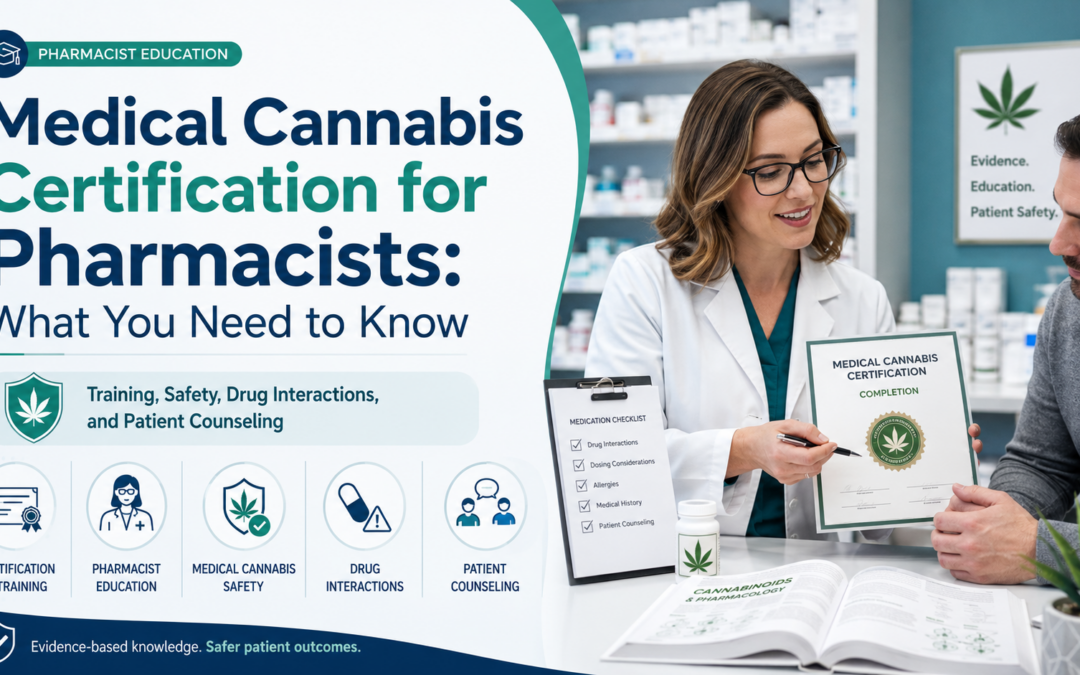
Medical cannabis certification for pharmacists is structured professional education that helps pharmacists build knowledge in cannabinoid science, patient counseling, medication safety, drug interactions, and legal awareness.
It can support more confident, evidence-based conversations about cannabis, but it does not replace pharmacy licensure, local regulations, clinical judgment, or patient-specific medical care.
As cannabis-related questions reach more community pharmacies, hospitals, clinics, universities, and healthcare teams, pharmacists need reliable education. Patients may ask about THC, CBD, product labels, side effects, drug interactions, or safe use.
A well-designed training program helps pharmacists respond with balanced information rather than hype, assumptions, or one-size-fits-all advice.
Cannabis is not risk-free. THC and CBD may cause side effects, may interact with medicines or other substances, and may affect people differently. Laws, product standards, labeling requirements, and pharmacist responsibilities can also vary by U.S. state and country.
Patients should speak with a pharmacist, physician, or qualified healthcare professional before making medical decisions.
Key Takeaways
- Medical cannabis certification for pharmacists can strengthen professional knowledge in cannabis safety, patient counseling, medication review, and clinical communication.
- A certificate is not the same as pharmacy licensure, prescribing authority, or legal authority to certify patients.
- A credible pharmacist cannabis certification should address THC, CBD, product variability, patient safety, drug interactions, legal awareness, and evidence evaluation.
- Cannabis may interact with prescription medicines, over-the-counter medicines, supplements, alcohol, and other substances.
- Pharmacists should understand that patient counseling must be individualized.
- Continuing education is important because the evidence, product landscape, regulations, and professional expectations continue to evolve.
- The goal of cannabis pharmacy education is safer, more informed care—not broad claims that cannabis is appropriate for every patient.
What Is Medical Cannabis Certification for Pharmacists?
Medical cannabis certification for pharmacists refers to structured education designed for pharmacy professionals who want deeper knowledge of cannabis-based medicines, cannabinoids, medication safety, patient counseling, and legal or regulatory considerations.
The purpose is not to create a universal “cannabis expert” overnight. Instead, it is to help pharmacists understand a complex field more responsibly.
A quality program should teach learners how to assess evidence, identify potential risks, communicate with patients, and recognize when referral or additional clinical review is needed.
Pharmacists are already trained in medication safety, pharmacology, patient communication, and drug-interaction screening. Cannabis-specific education can help apply those skills to cannabis-based medicines and cannabis-related products.
Certificate, Continuing Education, and Licensure: What Is the Difference?
Term | What It Usually Means | What It Does Not Automatically Mean |
Certificate program | Structured learning with defined content and completion requirements | Authority to prescribe or certify a patient |
Continuing education | Ongoing professional learning on a topic | Specialty licensure |
Pharmacy license | Legal authority to practice pharmacy in a jurisdiction | Automatic cannabis specialization |
Cannabis pharmacist role | Pharmacy practice supported by cannabis-specific knowledge | A universal legal title in every country or U.S. state |
A certificate can demonstrate learning and commitment to professional development. However, each pharmacist must still follow their own jurisdiction’s laws, employer policies, licensing rules, and scope-of-practice requirements.
Why Medical Cannabis Training for Pharmacists Matters
Cannabis questions are no longer limited to specialty settings. Pharmacists may hear them at the counter, during medication therapy management.
In hospital discharge counseling, through telehealth, in academic settings, or while supporting patients who use both prescription medicines and cannabis products.
A patient may ask:
- “Can I use CBD with my prescription medicine?”
- “What is the difference between THC and CBD?”
- “Will this product affect driving or work?”
- “Can medical cannabis interact with my blood thinner?”
- “Is this product safe because it is natural?”
- “Should I stop my medicine if cannabis helps my symptoms?”
These are not simple yes-or-no questions. They require a careful review of the patient’s health situation, medication list, cannabis product, route of use, local laws, and safety concerns.
Patients Need Reliable Information
Many people learn about cannabis through social media, product advertising, friends, online forums, or dispensary conversations. Some information may be useful, but it may not consider the patient’s complete medication list, health history, side-effect risks, or local regulations.
Pharmacists can add an important medication-safety perspective. They can help patients understand that “legal,” “plant-based,” “CBD,” or “medical” does not automatically mean risk-free or appropriate for every person.
Healthcare Teams Need Shared Language
Pharmacists, physicians, nurses, and other healthcare professionals benefit from consistent language around cannabis safety. Training can support better communication about:
- Medication reconciliation
- Drug interaction awareness
- Product labeling
- Side-effect monitoring
- Impairment risk
- Patient follow-up
- Legal and professional boundaries
- Referral to appropriate care
What Should a Credible Cannabis Course for Pharmacists Cover?
Not all programs offer the same depth, focus, or quality. A credible cannabis course for pharmacists should go beyond general information about cannabis history or products.
It should prioritize clinical evidence, patient safety, medication review, and professional responsibility.
Cannabinoid Science and the Endocannabinoid System
A strong program should introduce the foundations of cannabinoid science, including:
- Basic cannabinoid terminology
- THC and CBD differences
- Cannabinoid receptors and signaling concepts
- The endocannabinoid system
- Product formulation and route differences
- Why product concentration and labeling matter
This knowledge helps pharmacists explain complex information in simple language. It also supports better questions during patient counseling.
Suggested internal link: endocannabinoid system explained simply
THC, CBD, and Product Differences
THC and CBD are often discussed together, but they are not interchangeable. A quality program should explain that products may differ in cannabinoid content, formulation, route of administration, timing of effects, and impairment potential.
Pharmacists should understand key counseling points such as:
- THC may contribute to impairment and altered reaction time.
- CBD is not automatically free from side effects or drug-interaction concerns.
- Oral, inhaled, sublingual, topical, and other products can have different onset and duration profiles.
- Product labels may not always provide the same level of detail or quality assurance across jurisdictions.
- A patient’s previous cannabis experience does not guarantee safety with a new product.
Medical Cannabis Drug Interactions for Pharmacists
A major part of responsible cannabis education is learning how to approach potential medication interactions.
Cannabis and CBD products may interact with prescription medicines, over-the-counter medicines, supplements, alcohol, and other substances.
The level of concern depends on many factors, including product type, dose, route, frequency of use, patient health conditions, and the other medicines being used.
A pharmacist should be prepared to review:
- Medicines that cause sedation or impair alertness
- Anticoagulants or antiplatelet medicines
- Anti-seizure medicines
- Opioids and other central nervous system depressants
- Certain antidepressants or psychiatric medicines
- Medicines with narrow therapeutic ranges
- Multiple medicines used for chronic conditions
This is not a universal list of “safe” or “unsafe” combinations. It is a reminder that medication reconciliation and individualized review matter.
Medical Cannabis Patient Counselling for Pharmacists
Patient counseling should be practical, respectful, and non-judgmental. Patients may not disclose cannabis use if they expect criticism or feel embarrassed.
A pharmacist can create a better conversation by asking open-ended questions and focusing on safety.
Important counseling skills include:
- Asking why the patient is considering cannabis
- Reviewing all medicines, supplements, and substances
- Explaining that cannabis is not risk-free
- Discussing possible side effects and impairment
- Addressing driving, workplace, and storage concerns
- Encouraging patients not to change prescribed medicines independently
- Using teach-back to confirm understanding
- Identifying when a physician or specialist referral is needed
A helpful question may be: “What product are you using, how are you using it, and what other medicines or supplements do you take?” This invites a fuller safety conversation without making assumptions.
Do Pharmacists Need Certification for Medical Cannabis?
Whether pharmacists need a certificate depends on their professional goals, practice setting, employer expectations, local laws, and scope of practice.
In many places, pharmacists do not need a specific cannabis certificate simply to remain licensed as pharmacists.
However, additional education may be valuable for those who expect to answer cannabis-related questions, support patients using cannabis-based medicines, work in cannabis-related settings, teach future pharmacists, or strengthen their expertise in medication safety.
A certificate may help pharmacists develop more structured knowledge. It does not automatically grant authority to prescribe, recommend, certify patients, dispense cannabis, or provide services outside the pharmacist’s legal scope.
When Additional Training May Be Valuable
Structured training may be especially useful for:
- Community pharmacists
- Hospital pharmacists
- Ambulatory-care pharmacists
- Pharmacy students
- Educators and academic faculty
- Researchers
- Public-health professionals
- Professionals working in medical cannabis programs
- Healthcare teams developing patient-safety resources
What Certification Cannot Replace
Even the best medical cannabis certificate program for pharmacists cannot replace:
- Pharmacy licensure
- Local or national legal requirements
- Employer training and workplace policies
- Professional judgment
- Patient-specific medical assessment
- Communication with the patient’s healthcare team
- Referral when the pharmacist identifies a safety concern
How to Become a Cannabis Pharmacist
There is no single worldwide pathway because laws, pharmacy education requirements, and cannabis regulations differ by location. However, pharmacists can follow a practical professional-development path.
Step 1: Build a Strong Pharmacy Foundation
The first step is a pharmacy education and licensure pathway appropriate to the pharmacist’s jurisdiction. Pharmacists should understand their own legal scope, employer policies, and professional responsibilities before providing cannabis-related guidance.
Step 2: Develop Cannabis-Specific Knowledge
Education should cover more than products. It should include:
- Cannabinoid pharmacology
- THC and CBD differences
- Product formulations
- Drug interactions
- Adverse-effect awareness
- Patient counseling
- Evidence appraisal
- Legal and regulatory context
- Documentation and professional communication
Step 3: Choose a Structured Training Program
Before enrolling in an online medical cannabis certification for pharmacists, consider the following questions:
- Is the curriculum evidence-based?
- Are the instructors appropriately qualified?
- Does the program discuss patient safety and drug interactions?
- Does it explain legal and regulatory limits?
- Does it include patient counseling methods?
- Is there an assessment or competency component?
- Does the course clearly state its learning objectives?
- Are accreditation or continuing education details transparent?
Step 4: Keep Learning
Cannabis-related evidence, laws, products, and practice models can change. Completing a program should be viewed as a foundation, not the end of professional learning.
Pharmacists can continue building knowledge through current literature, public-health resources, professional education, peer discussion, webinars, and evidence-based membership communities.
Suggested internal links:
- continuing education for pharmacists
- ISCPh membership
- how to become a cannabis pharmacist
Online Medical Cannabis Certification for Pharmacists: What to Look For
Online learning can be especially useful for working pharmacists, pharmacy students, remote learners, and healthcare professionals who need flexible access to structured education.
However, flexibility should not come at the expense of quality.
Questions to Ask Before Choosing a Program
Use this checklist before enrolling:
- Does the program focus on evidence rather than marketing claims?
- Does it include THC, CBD, and product-variation education?
- Does it address patient safety, impairment, and side effects?
- Does it cover medication interactions?
- Does it explain legal and regulatory variability?
- Are faculty credentials visible?
- Is there a learning assessment or competency component?
- Does the content apply to pharmacy practice?
- Are continuing education or accreditation details clearly stated?
- Does the program acknowledge uncertainty where evidence is limited?
Compare Common Learning Formats
Learning Option | Best For | Main Limitation |
Introductory webinar | Basic awareness | Often limited in depth |
Cannabis course for pharmacists | Foundational professional learning | Curriculum quality can vary |
Continuing education module | Focused updates on one topic | May not provide broad competency |
Medical cannabis certificate program for pharmacists | Structured and comprehensive learning | Requires time and active participation |
Membership resources | Ongoing professional growth | Best used alongside formal education |
The Pharmacist Role in Medical Cannabis
The pharmacist role in medical cannabis is centered on medication expertise, patient communication, safety awareness, and collaboration with the healthcare team.
Pharmacists may support patients by helping them understand products, identify questions for their prescriber, review potential medication concerns, and recognize when professional follow-up is appropriate.
Medication Safety Review
A pharmacist can help patients think through questions such as:
- What prescription medicines are currently being taken?
- Are there over-the-counter products, vitamins, or supplements involved?
- Is alcohol or another impairing substance being used?
- Does the patient have a history of side effects or sensitivity?
- Does the patient understand product labeling?
- Could the patient be at risk of sedation or impaired coordination?
Patient Counseling and Teach-Back
Teach-back is useful because patients may nod during a conversation but still misunderstand key safety points.
For example, a pharmacist may ask:
- “What will you do if you feel unusually drowsy or dizzy?”
- “What should you check before using this with your other medicines?”
- “When should you avoid driving or operating equipment?”
- “Who will you contact if you have concerning symptoms?”
Interprofessional Communication
Cannabis-related questions often require shared decision-making. Pharmacists can support safer care by communicating with physicians, nurses, specialists, and patients within their authorized scope of practice.
Medical Cannabis Safety Warnings Every Pharmacist Should Understand
Cannabis education should never present THC, CBD, or medical cannabis as universally safe. Patient safety must remain central.
Cannabis Is Not Risk-Free
Possible risks and side effects can vary by person and product. Depending on the situation, patients may experience:
- Drowsiness or sedation
- Dizziness
- Reduced alertness
- Impaired coordination or reaction time
- Cognitive changes
- Anxiety or unwanted psychological effects
- Gastrointestinal symptoms
- Product-specific reactions
- Drug-interaction concerns
Product Quality and Labeling Can Vary
Cannabis products may differ in quality, testing, formulation, labeling, and cannabinoid content. These differences can vary by U.S. state, country, product source, and regulatory framework.
Pharmacists should avoid assuming that all “CBD,” “hemp,” “medical,” or “natural” products have consistent quality or predictable effects.
When to Refer a Patient
A pharmacist should encourage professional review when a patient:
- Uses multiple prescription medicines
- Has experienced concerning side effects
- Is pregnant, breastfeeding, or planning pregnancy
- Has complex health conditions
- Wants to stop or replace prescribed treatment
- Has questions about drug interactions
- Needs to drive or perform safety-sensitive work
- Is unsure about local rules or product labeling
Why This Topic Matters in the United States
The United States has a complex cannabis environment. Medical cannabis programs, product rules, qualifying conditions, patient registration systems, pharmacist roles, workplace protections, and transport restrictions can vary significantly from one state to another.
For pharmacists, this means that clinical knowledge alone is not enough. They also need awareness of their state’s laws, employer policies, pharmacy-board expectations, and local practice environment.
For patients, it means that information from another state may not apply where they live. A product available in one state may be restricted elsewhere, and product-labeling or testing standards may differ.
Why U.S. Pharmacists Need Practical Education
Cannabis-related questions may arise in:
- Community pharmacy
- Hospital pharmacy
- Ambulatory-care settings
- Academia
- Public health
- Research
- Patient education
- Cannabis-industry roles
Structured education can help pharmacists distinguish between legal access, clinical evidence, patient safety, and professional scope.
Worldwide Relevance for Pharmacists and Healthcare Professionals
Cannabis education is relevant beyond the United States. Pharmacists and healthcare professionals worldwide may encounter patients who use regulated cannabis-based medicines, CBD products, imported products, or self-directed cannabis.
However, laws and practice models vary widely. Some countries permit only certain cannabis-based medicines under strict controls.
Others restrict or prohibit most cannabis products. Pharmacy roles, product standards, prescribing requirements, and patient protections can also differ.
The shared global principles are clear:
- Use evidence carefully
- Prioritize patient safety
- Review medicines and other substances
- Communicate respectfully
- Understand local laws
- Stay within professional scope
- Refer when needed
A global audience should never assume that U.S. rules apply in another country, or that another country’s policies apply in the United States.
Common Myths and Mistakes About Pharmacist Cannabis Certification
Myth: A Certificate Gives Legal Authority Everywhere
A certificate may show that a pharmacist completed training. It does not automatically grant legal authority to prescribe, recommend, certify patients, or provide services outside local scope-of-practice rules.
Myth: All Cannabis Training Is the Same
Programs can differ greatly in quality. Some may focus mainly on product marketing, while others emphasize evidence, pharmacology, medication safety, counseling, legal awareness, and clinical decision-making.
Myth: CBD Does Not Require Medication Review
CBD may have safety and interaction considerations. Patients should not assume that CBD is harmless simply because it is widely available or non-intoxicating.
Myth: Natural Means Risk-Free
A product being plant-derived does not remove the need for safety review, medication reconciliation, or professional advice.
Mistake: Choosing a Course Based Only on Marketing Claims
Before enrolling, evaluate the faculty, curriculum, safety content, assessment process, accreditation information, legal awareness, and relevance to pharmacy practice.
Mistake: Treating Certification as the End of Learning
Cannabis education requires ongoing updates. New research, new products, and changing regulations can alter the questions pharmacists receive in practice.
When to Speak With a Cannabis Pharmacist or Healthcare Professional
Patients should speak with a cannabis pharmacist, physician, or qualified healthcare professional before making medical decisions if they:
- Take prescription medicines or multiple medicines
- Are considering THC- or CBD-containing products
- Have questions about possible interactions
- Experience side effects or impairment
- Are pregnant, breastfeeding, or planning pregnancy
- Have mental-health, cardiovascular, seizure-related, liver-related, or substance-use concerns
- Need to drive or work in a safety-sensitive role
- Are unsure about product labels, safe storage, or local laws
- Want to change prescribed medicines because of cannabis use
Healthcare professionals should seek additional education, consultation, or referral when they are unsure about medication safety, legal scope, product quality, or current evidence.
Why Choose cannabispharmacist for Evidence-Based Cannabis Education
cannabis pharmacist and ISCPh support pharmacists, pharmacy students, healthcare professionals, and informed patients who want an evidence-based approach to cannabis education.
The focus is not on hype, miracle claims, or universal product recommendations. The focus is on pharmacist-led education, medication safety, patient counseling, drug interaction awareness, legal context, and professional development.
Pharmacist-Led Learning
Pharmacists need education that fits real practice. This includes how to review medicines, answer patient questions, recognize safety concerns, and communicate clearly with healthcare teams.
The Clinical Cannabinoid Pharmacy Certificate
The Clinical Cannabinoid Pharmacy Certificate is designed to support healthcare professionals who want structured learning in clinical cannabinoid pharmacy.
Before publishing this article, confirm all current program details directly from the official CCPC page, including curriculum, eligibility, continuing education status, delivery format, pricing, assessment requirements, and registration availability.
Continuing Education and Professional Development
Cannabis education should not end after one course. Ongoing learning can help pharmacists stay aware of evolving evidence, legal issues, patient questions, and medication-safety concerns.
Membership and Professional Community
Professional membership can support continued learning through resources, community discussion, education opportunities, and pharmacist-focused updates.
Build Your Cannabis Pharmacy Knowledge With cannabispharmacist
Ready to strengthen your understanding of patient counseling, medical cannabis safety, cannabinoid science, and medication interactions?
Explore the Clinical Cannabinoid Pharmacy Certificate, access continuing education for pharmacists, and consider ISCPh membership for evidence-based learning, pharmacist-led resources, and professional development.
FAQs
Do pharmacists need certification for medical cannabis?
Not always. Requirements depend on local laws, practice setting, employer expectations, and professional goals. Additional education may help pharmacists build relevant knowledge and confidence.
How do I become a cannabis pharmacist?
The path generally includes pharmacy education and licensure, followed by cannabis-specific learning in pharmacology, patient safety, counseling, drug interactions, and legal awareness.
What should a cannabis course for pharmacists include?
A strong course should include cannabinoid science, THC and CBD, product differences, patient counseling, drug interactions, side effects, evidence evaluation, and legal considerations.
Can pharmacists counsel patients about medical cannabis?
Pharmacists may provide education on safety, medicine interactions, product differences, and patient counseling within their authorized scope of practice.
Can CBD interact with prescription medicines?
Yes. CBD may interact with some medicines. Patients should discuss CBD and cannabis use with a pharmacist, physician, or qualified healthcare professional.
Is an online medical cannabis certification for pharmacists credible?
It can be credible when it has a clear evidence-based curriculum, qualified faculty, medication-safety content, assessment standards, and transparent accreditation details.
Does a certificate allow a pharmacist to prescribe or recommend cannabis?
Not automatically. A certificate does not independently grant legal authority. Scope of practice depends on jurisdiction, licensure, workplace rules, and applicable laws.
Why should pharmacists learn about cannabis drug interactions?
Cannabis and CBD products may interact with prescription medicines, over-the-counter products, supplements, alcohol, and other substances. Training supports safer medication review and patient counseling.