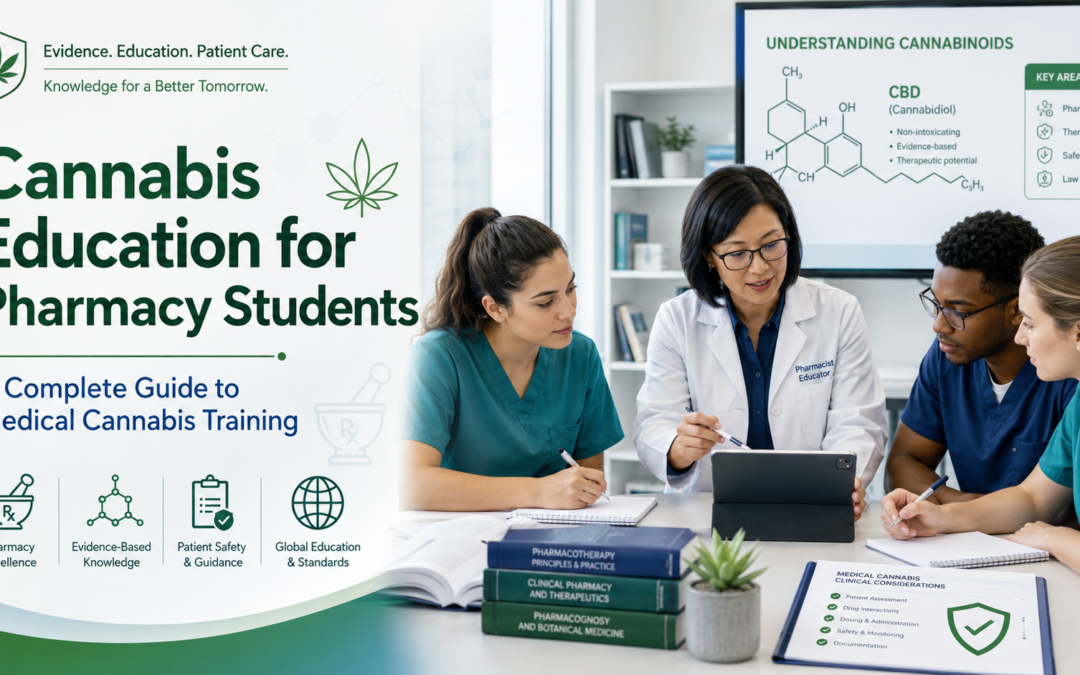
Cannabis education for pharmacy students is essential because future pharmacists need to understand medical cannabis safety, cannabinoid pharmacology, drug interactions, patient counseling, and legal responsibilities.
As cannabis access expands across the United States and worldwide, pharmacy students must be prepared to answer patient questions with evidence-based, balanced, and safety-focused guidance.
Medical cannabis training does not mean presenting cannabis as risk-free or recommending it to every patient. Instead, it means helping future pharmacists understand cannabis.
THC, CBD, cannabinoids, product quality, regulations, and patient-specific risks fit into modern medication safety and healthcare decision-making.
This complete guide explains why pharmacy students should learn about cannabis, what medical cannabis education should include.
How cannabis pharmacists support safer patient care, and how professional training can help students build confidence in this evolving area of pharmacy practice.
Key Takeaways
- Cannabis education for pharmacy students helps future pharmacists understand medical cannabis safety, drug interactions, cannabinoid science, and patient counseling.
- Medical cannabis training should include the endocannabinoid system, THC, CBD, cannabis pharmacology, product quality, legal issues, and evidence-based clinical communication.
- Cannabis is not risk-free. THC and CBD may cause side effects and may interact with prescription medications, over-the-counter medicines, supplements, alcohol, and other substances.
- Cannabis laws vary by U.S. state and by country, so students must understand both clinical and regulatory boundaries.
- Pharmacists are medication experts and can play an important role in helping patients make safer, more informed cannabis-related decisions.
- Professional organizations such as cannabispharmacist / ISCPh can support students, pharmacists, and healthcare professionals through education, membership, continuing education, certification support, and evidence-based resources.
What Is Cannabis Education for Pharmacy Students?
Cannabis education for pharmacy students is structured learning about cannabis science, medical cannabis use, cannabinoid pharmacology, product safety, drug interactions, legal responsibilities, and pharmacist-led patient counseling.
It is not casual cannabis content. It is not a marketing language. It is not a one-sided discussion of benefits.
A strong cannabis pharmacy student education program should help future pharmacists think critically, evaluate evidence, communicate risks clearly, and support patient safety.
A complete cannabis education program may include:
- The endocannabinoid system
- THC, CBD, and minor cannabinoids
- Cannabis pharmacology for pharmacy students
- Routes of administration
- Onset and duration of cannabis products
- Medical cannabis safety concerns
- Cannabis drug interactions
- Patient counseling strategies
- Product quality and labeling issues
- Legal and regulatory differences
- Pharmacist scope of practice
- Ethical communication
- Clinical documentation
- Referral to qualified healthcare professionals
Pharmacy students do not need cannabis education because every patient should use cannabis.
They need cannabis education because many patients already use or ask about cannabis, CBD, hemp-derived products, medical marijuana, and cannabinoid-based products. Pharmacists must be prepared to respond with accuracy, caution, and professionalism.
Why Should Pharmacy Students Learn About Cannabis?
Pharmacy students should learn about cannabis because pharmacists are medication experts, and patients often ask medication-related questions about cannabis, CBD, THC, drug interactions, side effects, product selection, and safety.
A patient may ask:
- “Can I take CBD with my prescription medication?”
- “Is THC safe for sleep?”
- “Will cannabis interact with my anxiety medication?”
- “Can I use cannabis before surgery?”
- “Is a CBD gummy the same as a prescription cannabis-derived medication?”
- “Can I drive after using medical cannabis?”
- “What should I know before using cannabis with alcohol?”
Without proper education, future pharmacists may feel unprepared. With evidence-based cannabis training, pharmacy students can learn how to ask better questions, identify risks, avoid unsupported claims, and refer patients appropriately.
Pharmacy Students Need Cannabis Education Because Patients Need Better Guidance
Many patients get cannabis information from friends, social media, dispensaries, product labels, advertising, or online forums. Some of that information may be incomplete, outdated, exaggerated, or unsafe.
Pharmacists can help patients understand:
- Cannabis is not risk-free.
- THC can cause impairment.
- CBD may cause side effects.
- Cannabis products can interact with medications.
- Product quality may vary.
- Laws differ by location.
- Medical decisions should involve qualified healthcare professionals.
This is where cannabis education for pharmacy students becomes a public-health issue, not just a professional-interest topic.
Can Pharmacy Students Study Medical Cannabis?
Yes. Pharmacy students can study medical cannabis through professional education programs, pharmacy school electives, continuing education resources, student pharmacist societies.
Cannabis pharmacy organizations, journal clubs, certificate programs, clinical case discussions, and peer-reviewed literature.
Medical cannabis education for pharmacy students may be offered through:
- Pharmacy school courses or electives
- Professional cannabis pharmacy organizations
- Continuing education programs
- Clinical cannabinoid pharmacy certificate programs
- Student cannabis pharmacy societies
- Pharmacist-led webinars
- Journal clubs
- Patient case reviews
- Research projects
- State cannabis board resources
- Professional pharmacy associations
When choosing cannabis training for pharmacy students, learners should look for programs that are evidence-based, pharmacist-led, safety-focused, and updated regularly.
Cannabis science and regulations continue to evolve, so training should not rely on outdated information or unsupported claims.
Every Pharmacy Student Should Learn in Medical Cannabis Training
Medical cannabis training for pharmacy students should be built like a clinical foundation. Students should understand the science, safety, patient communication, and legal context before discussing cannabis-related questions in practice.
1. Endocannabinoid System for Pharmacy Students
The endocannabinoid system is a biological signaling system involved in many processes, including pain modulation, appetite, mood, sleep, memory, immune function, and homeostasis. Pharmacy students should learn how endocannabinoids, cannabinoid receptors, and cannabis-derived compounds may interact with this system.
Important concepts include:
- CB1 receptors
- CB2 receptors
- Anandamide
- 2-AG
- Endocannabinoid metabolism
- Receptor distribution
- Relationship between cannabinoids and physiologic effects
The goal is not to oversimplify the system. The goal is to help pharmacy students understand why cannabinoids may have different effects depending on dose, route, product type, patient characteristics, and concurrent medications.
[Citation placeholder: NIH/NCCIH or PubMed review on endocannabinoid system]
2. Cannabinoid Education for Pharmacy Students
Cannabinoids are chemical compounds that can interact with cannabinoid receptors or related pathways. The most commonly discussed cannabinoids are THC and CBD, but students should also understand that cannabis contains many other compounds.
Key cannabinoids include:
- THC
- CBD
- CBG
- CBN
- CBC
- THCA
- CBDA
- THCV
THC is commonly associated with intoxicating effects and impairment. CBD is often marketed as non-intoxicating, but non-intoxicating does not mean risk-free. CBD may still cause side effects and may interact with medications.
Pharmacy students should also understand that cannabinoid content can vary across products. A patient using a high-THC inhaled product may have very different safety concerns than a patient using an oral CBD product.
3. Cannabis Pharmacology for Pharmacy Students
Cannabis pharmacology for pharmacy students should include pharmacokinetics, pharmacodynamics, absorption, distribution, metabolism, elimination, dose-response variability, and route-specific effects.
Students should understand that cannabis effects can vary based on:
- Product type
- THC and CBD content
- Route of administration
- Patient tolerance
- Frequency of use
- Body composition
- Liver function
- Other medications
- Age
- Pregnancy status
- Mental health history
- Cardiovascular risk
- Substance use history
Routes of administration may include:
- Inhalation
- Oral ingestion
- Sublingual or buccal use
- Topical products
- Transdermal products
A key counseling point is that oral cannabis products often have delayed onset compared with inhaled products.
This matters because patients may accidentally take more if they do not feel effects quickly. Pharmacy students should learn how to explain onset and duration in simple, safety-focused language.
4. Medical Cannabis Safety
Medical cannabis safety is one of the most important areas of cannabis pharmacy education. Students should learn how to communicate both potential therapeutic interest and possible risks without exaggeration.
Potential safety concerns may include:
- Impairment
- Drowsiness
- Dizziness
- Anxiety
- Paranoia
- Changes in mood
- Cognitive effects
- Increased heart rate
- Coordination issues
- Driving safety concerns
- Lung health concerns with smoking
- Pregnancy and breastfeeding concerns
- Cannabis use disorder risk
- Drug interaction concerns
- Product contamination or labeling problems
Medical cannabis education should never present cannabis as harmless. It should train students to ask patient-specific questions and identify when referral to a pharmacist, physician, or other qualified healthcare professional is needed.
5. Cannabis Drug Interactions
Cannabis may interact with prescription medications, over-the-counter medicines, supplements, alcohol, and other substances. This is one of the clearest reasons pharmacists need cannabis training.
Potential interaction concerns may involve:
- Sedatives
- Alcohol
- Opioids
- Benzodiazepines
- Antidepressants
- Antipsychotics
- Antiepileptic medications
- Anticoagulants
- Cardiovascular medications
- Immunosuppressants
- Other high-risk therapies
Cannabinoids may affect medication metabolism or add to central nervous system effects. The clinical significance depends on the patient, medication, dose, formulation, route, frequency, and overall medical condition.
Pharmacy students should not memorize a simple “safe” or “unsafe” list. Instead, they should learn a structured interaction-screening process.
A practical framework includes:
- Identify the cannabis product.
- Identify THC and CBD content.
- Ask about route, frequency, and timing.
- Review prescription medications.
- Review OTC medicines and supplements.
- Screen for alcohol or sedating substances.
- Assess patient risk factors.
- Recommend professional evaluation when needed.
- Document counseling and referral.
Why This Topic Matters in the United States
Cannabis education for pharmacy students is especially important in the United States because cannabis laws vary significantly by state, while federal cannabis regulation remains complex.
In some states, medical cannabis programs are well established. In others, access may be limited or governed by different qualifying conditions, product rules, registration systems, and professional requirements.
Hemp-derived products, including CBD products, are also widely available, but quality, labeling, and regulatory oversight can vary.
For pharmacy students in the USA, this creates several challenges:
- Patients may use cannabis legally under state law.
- Patients may buy CBD products outside a medical system.
- Product labels may be confusing.
- THC content may vary.
- Some products may contain unexpected ingredients or contaminants.
- Pharmacists may be asked for advice even if they do not dispense cannabis.
- Federal and state rules may not align.
- Professional scope of practice may vary by state.
This is why U.S. pharmacy students need both clinical and legal awareness. They should be trained to say, “Cannabis laws and professional responsibilities vary by state.
Let’s review safety factors and make sure you speak with the appropriate qualified healthcare professional.”
Why Cannabis Pharmacy Education Matters Globally
Medical cannabis is not only a U.S. issue. Countries around the world are developing different cannabis policies, medical access systems, research programs, and professional education models.
Worldwide readers may face different realities:
- Cannabis may be legal, restricted, or prohibited.
- Medical cannabis may require special authorization.
- CBD may be regulated differently from THC.
- Product standards may vary.
- Pharmacist involvement may differ by country.
- Patients may still use cannabis even where legal access is limited.
- Healthcare professionals may receive little formal cannabis training.
For global pharmacists and healthcare professionals, the central responsibility is the same: protect patient safety through evidence-based guidance.
Cannabis pharmacy education can help global healthcare professionals:
- Understand cannabinoid science
- Identify potential medication interactions
- Discuss risks without stigma
- Avoid unsupported medical claims
- Encourage professional medical decision-making
- Recognize legal limits
- Support patient-centered care
Because laws vary by country, the final article should remind readers to check their local laws, national regulatory agencies, pharmacy boards, and professional practice standards.
Why Pharmacist-Led Cannabis Education Builds Trust
Cannabis is a YMYL topic because it relates to health, medication safety, legal risk, and patient decision-making. For this reason, content about medical cannabis should be accurate, balanced, transparent, and reviewed by qualified professionals.
A strong EEAT-focused cannabis article should demonstrate:
Pharmacist Expertise
Pharmacists are trained in pharmacology, medication therapy, patient counseling, drug interactions, adverse effects, and safe medication use. This makes pharmacists well suited to help patients understand cannabis-related medication questions.
Evidence-Based Cannabis Education
Evidence-based education means using credible sources such as FDA, NIH, NCCIH, CDC, PubMed, peer-reviewed studies, state cannabis boards, and professional pharmacy organizations. It also means being honest about evidence gaps.
Medical Cannabis Safety
Safety-focused education should explain that cannabis, THC, CBD, and cannabinoid products may cause side effects. It should avoid overstating benefits or minimizing risks.
Drug Interaction Awareness
Drug interaction screening is one of the most important pharmacist-led services in cannabis education. Pharmacy students should understand how to evaluate interaction risk rather than relying on generic claims.
Patient Counseling
Patient counseling should be nonjudgmental, clear, and practical. Patients should feel comfortable disclosing cannabis use, CBD use, alcohol use, supplement use, and medication concerns.
Professional Training
Medical cannabis training for pharmacy students and residents should include case-based learning, evidence review, clinical reasoning, and legal/regulatory awareness.
Legal and Regulatory Awareness
Because cannabis laws vary by U.S. state and by country, pharmacists and students must understand the legal context of practice. Education should not encourage patients to violate local laws or bypass professional care.
Practical Checklist for Pharmacy Students Learning About Cannabis
Learning Area | What to Understand | Why It Matters |
Endocannabinoid system | CB1, CB2, endocannabinoids | Builds scientific foundation |
THC vs CBD | Different effects and risks | Helps explain patient safety |
Cannabis pharmacology | Route, onset, duration, metabolism | Supports accurate counseling |
Drug interactions | Prescription, OTC, supplements, alcohol | Reduces preventable harm |
Side effects | Impairment, sedation, anxiety, dizziness | Helps patients recognize risks |
Product quality | Potency, labeling, testing, contamination | Supports safer product questions |
Legal rules | State and country differences | Prevents unsafe legal assumptions |
Patient counseling | Nonjudgmental questions and referral | Improves communication |
Evidence review | FDA, NIH, NCCIH, CDC, PubMed | Builds clinical credibility |
Professional development | CE, certificate, membership | Supports career growth |
Common Myths and Mistakes About Cannabis Education
Myth 1: Cannabis Is Natural, So It Is Always Safe
Natural substances can still cause side effects, interactions, and harm. Pharmacy students should avoid assuming that natural products are automatically safe.
Myth 2: CBD Has No Risks
CBD is often described as non-intoxicating, but it may still cause side effects and may interact with medications. Students should discuss CBD with the same professional caution used for other bioactive substances.
Myth 3: THC and CBD Are Basically the Same
THC and CBD have different pharmacologic profiles. THC is commonly associated with intoxication and impairment, while CBD has different safety considerations, including possible medication interaction concerns.
Myth 4: All Cannabis Products Are Equal
Cannabis products vary by THC content, CBD content, formulation, route, onset, duration, quality, labeling accuracy, and regulatory oversight.
Myth 5: Pharmacists Only Need Cannabis Education If They Work in a Dispensary
Patients may ask any pharmacist about cannabis, CBD, THC, interactions, side effects, or safety. Community pharmacists, hospital pharmacists, ambulatory care pharmacists, consultants, and students can all benefit from cannabis education.
Myth 6: Medical Cannabis Training Should Only Focus on Benefits
A responsible curriculum must cover benefits, risks, limitations, evidence gaps, adverse effects, interactions, legal issues, and patient referral.
When to Speak With a Cannabis Pharmacist or Healthcare Professional
Patients, students, and healthcare professionals should speak with a cannabis pharmacist, physician, or qualified healthcare professional when there is uncertainty about safety, medication interactions, legal rules, or patient-specific risks.
This is especially important when a patient:
- Takes prescription medications
- Uses OTC medicines or supplements
- Drinks alcohol or uses sedating substances
- Is pregnant or breastfeeding
- Is elderly
- Has liver disease
- Has heart disease
- Has a history of psychosis, severe anxiety, or other mental health concerns
- Has a substance use disorder history
- Is preparing for surgery
- Experiences side effects
- Uses high-THC products
- Uses multiple cannabis products
- Is unsure about product labeling
- Needs help understanding legal access
Pharmacist-led guidance does not replace medical care. It supports safer decision-making by helping patients understand medication-related risks and know when to involve other healthcare professionals.
Cannabis Pharmacist Career Path for Pharmacy Students
A cannabis pharmacist career path may interest pharmacy students who want to specialize in cannabinoid science, medical cannabis safety, patient counseling, education, research, policy, or professional training.
Possible career areas include:
- Medical cannabis patient counseling
- Cannabis pharmacy education
- Continuing education instruction
- Clinical cannabinoid training
- Dispensary or medical cannabis consulting
- Drug interaction review
- Policy and regulatory work
- Cannabis safety education
- Research and literature review
- Product quality and compliance roles
- Professional association involvement
- Patient advocacy
Students interested in this path should build skills in:
- Pharmacology
- Evidence evaluation
- Medical writing
- Patient communication
- Drug interaction analysis
- Regulatory awareness
- Professional ethics
- Clinical documentation
- Interprofessional collaboration
A cannabis pharmacist career path should be built on evidence, not hype. The goal is to support safe, informed, and responsible patient care.
Why Choose cannabispharmacist for Evidence-Based Cannabis Education
A cannabis pharmacist, through ISCPh, is positioned around cannabis pharmacist education, medical cannabis training, professional development, continuing education, certification support, clinical resources, and pharmacist-led cannabis safety guidance.
For pharmacy students, pharmacists, and healthcare professionals, this matters because cannabis education should come from professionals who understand medication safety, patient counseling, legal complexity, and evidence-based healthcare.
cannabis pharmacist can support learners through:
- Cannabis pharmacy education
- Medical cannabis education
- Cannabis education for pharmacists
- Cannabis education for pharmacy students
- Continuing education
- Clinical cannabinoid pharmacy certificate support
- Professional membership
- Student pharmacist engagement
- Journal clubs
- Patient case discussions
- Professional networking
- Evidence-based cannabis resources
Students and professionals should look for education that is balanced, updated, clinically responsible, and transparent about both known evidence and uncertainty.
How Pharmacy Students Can Start Medical Cannabis Training
Step 1: Learn the Basics of Cannabis Science
Start with the endocannabinoid system, cannabinoids, THC, CBD, product types, and route differences.
Step 2: Study Safety Before Benefits
Understand impairment, side effects, drug interactions, product quality, patient risk factors, and referral situations.
Step 3: Practice Patient Counseling
Learn how to ask nonjudgmental questions such as:
- “Are you using any cannabis, CBD, or hemp-derived products?”
- “What product are you using?”
- “How often do you use it?”
- “Do you know the THC or CBD amount?”
- “Are you taking any prescription medications, OTC medicines, supplements, or alcohol?”
Step 4: Review Credible Sources
Use reputable sources such as FDA, NIH, NCCIH, CDC, PubMed, peer-reviewed studies, state cannabis boards, and professional pharmacy organizations.
Step 5: Join a Professional Learning Community
Consider student societies, professional memberships, continuing education, and pharmacist-led training opportunities.
Step 6: Keep Learning
Cannabis science and regulations change over time. Pharmacy students should continue updating their knowledge throughout their careers.
If you are a pharmacy student, pharmacist, healthcare professional, or cannabis industry professional seeking evidence-based cannabis education.
Cannabispharmacist / ISCPh can help you build a stronger foundation in medical cannabis safety, cannabinoid science, patient counseling, drug interactions, and professional development.
Explore cannabis pharmacy education, join ISCPh, access professional cannabis resources, learn from cannabis pharmacists, and start building the knowledge needed to support safer, evidence-based cannabis care.
Suggested CTA buttons:
- Join ISCPh
- Explore Cannabis Pharmacy Education
- Start Evidence-Based Cannabis Training
- Learn From Cannabis Pharmacists
- Access Professional Cannabis Resources
- Explore Continuing Education
- Learn About Membership
FAQs
What is cannabis education for pharmacy students?
Cannabis education for pharmacy students is training on cannabinoid science, medical cannabis safety, cannabis pharmacology, drug interactions, legal issues, and pharmacist-led patient counseling.
Why should pharmacy students learn about cannabis?
Pharmacy students should learn about cannabis because patients may ask pharmacists about CBD, THC, medical cannabis, side effects, product safety, and drug interactions.
Can pharmacy students study medical cannabis?
Yes. Pharmacy students can study medical cannabis through pharmacy courses, continuing education, professional organizations, certificate programs, student societies, and evidence-based cannabis resources.
What should medical cannabis training for pharmacy students include?
Medical cannabis training should include the endocannabinoid system, THC, CBD, cannabinoid pharmacology, safety risks, drug interactions, patient counseling, product quality, and legal awareness.
Is cannabis risk-free?
No. Cannabis is not risk-free. THC and CBD may cause side effects, impairment, drug interactions, and other safety concerns depending on the patient and product.
Can cannabis interact with medications?
Yes. Cannabis and cannabinoid products may interact with prescription medications, OTC medicines, supplements, alcohol, and sedating substances. Patients should ask a pharmacist or healthcare professional.
Are cannabis laws the same in every state?
No. Cannabis laws vary by U.S. state and by country. Pharmacy students and patients should check current local laws and professional regulations.
What is a cannabis pharmacist?
A cannabis pharmacist is a pharmacist with specialized knowledge in cannabinoid science, cannabis pharmacology, drug interactions, patient counseling, product safety, and medical cannabis education.
Is CBD safer than THC?
CBD is generally considered non-intoxicating, while THC can cause intoxication and impairment. However, CBD is not risk-free and may cause side effects or interact with medications.
Where can pharmacy students find cannabis training?
Pharmacy students can find cannabis training through cannabispharmacist / ISCPh, continuing education programs, cannabis pharmacy organizations, clinical cannabinoid certificate programs, and peer-reviewed resources.