
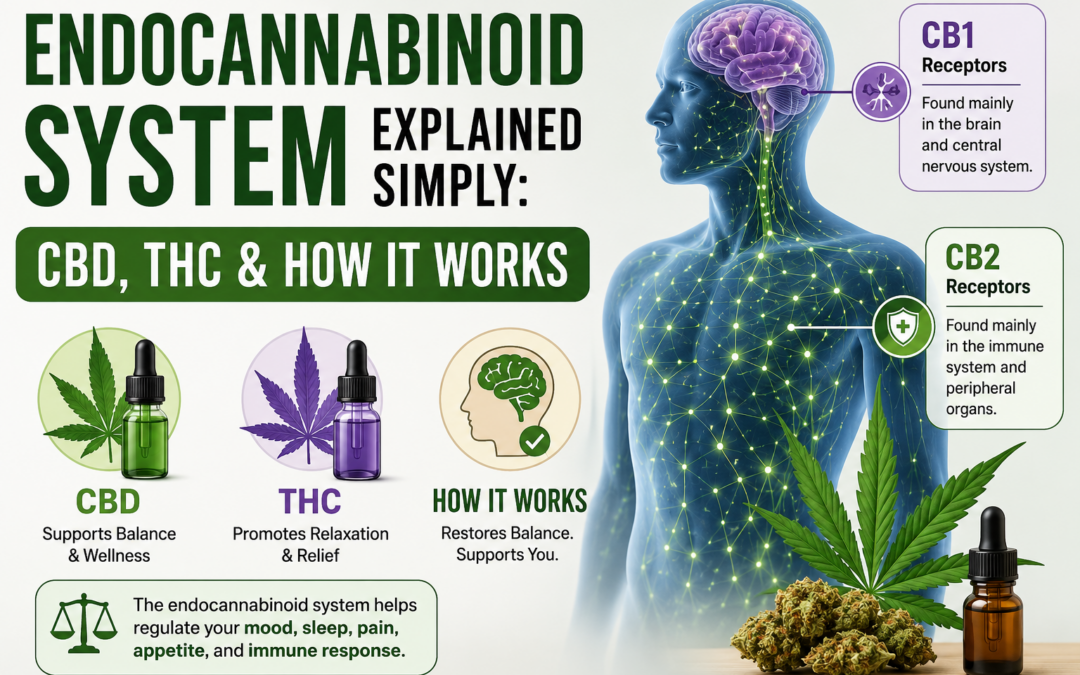
The endocannabinoid system explained simply is a way to understand how the human body naturally maintains balance and how compounds like CBD and THC interact with it.
The endocannabinoid system (ECS) is a biological network that regulates key functions such as mood, sleep, appetite, pain, and immune response.
In this guide from cannabispharmacist, we break down the ECS in a simple, science-based, pharmacist-led way for patients, pharmacists, and healthcare professionals worldwide.
Key Takeaways (Featured Snippet Summary)
- The endocannabinoid system helps maintain homeostasis (body balance)
- It includes CB1 receptors, CB2 receptors, enzymes, and endocannabinoids
- THC primarily interacts with CB1 receptors in the brain
- CBD interacts indirectly with the ECS
- The ECS is present in every human body
- Cannabis affects this system but does not create it
- Pharmacist guidance improves safety and understanding
What Is the Endocannabinoid System? (Primary Keyword Section)
The endocannabinoid system explained simply refers to a natural regulatory system in the human body that helps maintain internal balance.
What does the endocannabinoid system do?
It helps regulate:
- Mood and emotional response
- Sleep cycles
- Appetite and digestion
- Pain signaling
- Immune system activity
The ECS is not caused by cannabis. It already exists in the human body.
How Does the Endocannabinoid System Work?
The ECS works through a three-part biological system:
1. Endocannabinoids
These are naturally produced chemicals in the body that act like messengers.
2. Receptors (CB1 and CB2)
These are “binding sites” where signals are received.
3. Enzymes
These break down endocannabinoids after they are used.
CB1 and CB2 Receptors Explained Simply
CB1 Receptors
- Found mostly in the brain and central nervous system
- Influence mood, memory, coordination, and perception
CB2 Receptors
- Found mainly in immune system tissues
- Related to inflammation and immune response
Quick Comparison Table
|
Feature |
CB1 Receptors |
CB2 Receptors |
|
Location |
Brain & CNS |
Immune system |
|
Function |
Neurological activity |
Immune regulation |
|
THC interaction |
Strong binding |
Minimal |
How Does Cannabis Interact With the Endocannabinoid System?
Endocannabinoid System and THC
THC (tetrahydrocannabinol) binds strongly to CB1 receptors, which explains its psychoactive effects.
This interaction may influence:
- Perception
- Mood changes
- Cognitive function
Endocannabinoid System and CBD
CBD (cannabidiol) does not strongly bind to CB1 or CB2 receptors. Instead, it:
- Modulates receptor activity indirectly
- Influences enzyme activity
- May affect signaling pathways related to balance
Endocannabinoid System for Beginners
Think of the ECS as a biological balancing system:
- Too much stress: ECS helps regulate response
- Poor sleep: ECS helps adjust cycles
- Pain signals: ECS helps modulate perception
Simple Analogy
The ECS works like a thermostat in your home:
- It keeps internal systems balanced
- It adjusts when something is too high or too low
Why Is the Endocannabinoid System Important?
The ECS is important because it:
- Supports overall physiological balance
- Connects nervous system and immune system communication
- Helps regulate multiple biological functions at once
Understanding it is essential for:
- Pharmacists
- Healthcare professionals
- Medical cannabis education
Endocannabinoid System and Cannabis: Clinical Perspective
Cannabis interacts with the ECS differently depending on:
- THC vs CBD ratio
- Product type
- Individual biology
- Dosage variability
Why This Matters in Pharmacy Practice
Pharmacists must understand:
- Drug interactions
- Patient variability
- Safety concerns
- Product quality differences
USA-Focused Importance of ECS Education
In the United States:
- Cannabis laws vary by state
- Medical and recreational systems differ
- Product labeling is not fully standardized nationwide
This creates a need for:
- Pharmacist-led education
- Patient safety frameworks
- Evidence-based cannabis counseling
Global Relevance of the Endocannabinoid System
Worldwide, ECS education is important because:
- Cannabis regulations differ across countries
- Medical cannabis adoption is increasing globally
- Standardized clinical education is still developing
Healthcare professionals globally need:
- Unified cannabinoid education frameworks
- Pharmacology-based training
- Safety-focused patient counseling models
Common Misconceptions About the Endocannabinoid System
Myth 1: Cannabis creates the ECS
❌ False: the ECS exists naturally in all humans
Myth 2: CBD and THC act the same way
❌ False: they interact differently with receptors
Myth 3: More ECS activation is always better
❌ False: balance, not overstimulation, is key
Safety and Clinical Considerations
Cannabis-related products may involve safety risks:
- THC may cause psychoactive effects
- CBD may interact with medications
- Drug interactions may occur via liver enzymes (CYP450 system)
- Product quality varies by regulation and region
- Effects differ widely between individuals
Always consult a healthcare professional before use.
When to Speak With a Cannabis Pharmacist or Healthcare Professional
You should seek professional guidance if:
- You are taking prescription medications
- You are new to cannabis-based products
- You experience side effects
- You have chronic medical conditions
- You are unsure about product selection or dosing
Why Choose cannabispharmacist for ECS Education?
CannabisPharmacist provides:
- Pharmacist-led cannabis education
- Evidence-based cannabinoid science training
- Safety-focused clinical learning
- Drug interaction awareness
- Professional certification and continuing education
Our mission is to improve global cannabis pharmacy education through science-based learning.
Advance your understanding of cannabinoid science with cannabispharmacist.
Explore pharmacist-led cannabis education, clinical training, and evidence-based resources designed for healthcare professionals, pharmacy students, and patients worldwide.
Visit https://cannabispharmacist.org/ to access cannabis pharmacy education, certification programs, and professional learning pathways.
FAQs
What does the endocannabinoid system do?
It helps regulate key biological functions including mood, pain, sleep, and immune response.
How does THC affect the endocannabinoid system?
THC binds mainly to CB1 receptors in the brain, influencing perception and mood.
How does CBD affect the endocannabinoid system?
CBD interacts indirectly with the ECS and does not strongly bind to CB1 or CB2 receptors.
What are CB1 and CB2 receptors?
CB1 receptors are found in the brain, while CB2 receptors are mainly in the immune system.
Why is the endocannabinoid system important?
It helps maintain internal balance and supports multiple essential body functions.
Does everyone have an endocannabinoid system?
Yes, all humans naturally have an ECS.
Is cannabis the same as the endocannabinoid system?
No, cannabis is a plant; the ECS is a biological system in the human body.